

Your data warehouse holds the complete picture of your customers. Behavioral patterns, predictive scores, enriched segments, it’s all there. But your sales team is working with stale CRM data. Your marketing team can’t access those high-value audiences. And your RevOps team is stuck writing CSV exports every week.
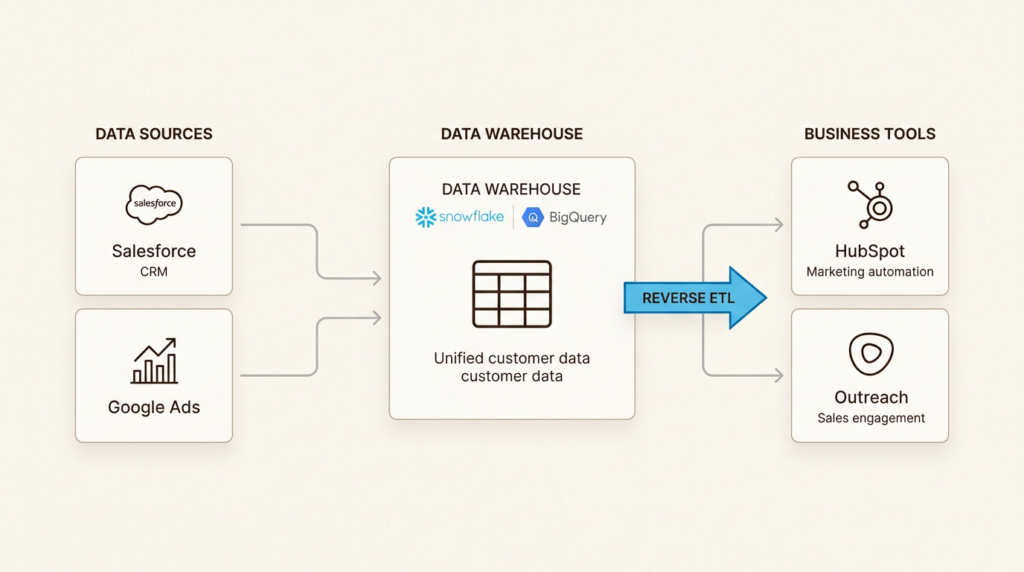
This is the problem Reverse ETL solves. Instead of pulling data into your warehouse (traditional ETL), Reverse ETL pushes warehouse data back into the tools your teams use daily. It turns your Snowflake or BigQuery instance into the single source of truth for your entire GTM stack.
Let’s break down the 7 best Reverse ETL tools for 2026, evaluated specifically for GTM use cases. I’ve tested these platforms, verified pricing from official sources, and focused on what matters for revenue teams: destination coverage for sales and marketing tools, sync reliability, and true cost at scale.
What is Reverse ETL (and why GTM teams should care)
Reverse ETL is a data pipeline architecture that moves data from your warehouse to operational systems. Traditional ETL flows like this: source systems (your CRM, ad platforms, product database) → transformation → data warehouse. Reverse ETL flips the direction: warehouse → business applications.
Here’s why this matters for GTM teams in 2026:
- Your warehouse has the good data. It’s where your data team has built unified customer profiles, calculated lead scores, and identified churn risks. That intelligence rarely makes it back to Salesforce or HubSpot.
- AI copilots need activated data. The LLM powering your sales team’s workflow can’t query Snowflake directly. It needs that data in the CRM where it can actually use it.
- Real-time personalization is now table stakes. Waiting 24 hours for a lead score to sync means missing the window when a prospect is actively engaged.
The technical skills for managing this stack are part of what defines a modern GTM Engineer. You’re not just managing tools, you’re architecting how data flows through your revenue engine.
How we evaluated these Reverse ETL tools
Before diving into the tools, here’s the framework I used to evaluate each platform:
- Destination coverage for GTM tools. How well does it support your actual stack? Salesforce and HubSpot are table stakes. I looked for Outreach, Salesloft, Apollo, and ad platform support.
- Sync latency. Batch (hourly/daily) works for some use cases. Real-time or near real-time (sub-15-minute) matters for lead routing and ad suppression.
- Warehouse integration. Native support for Snowflake, BigQuery, Redshift, and Databricks. Bonus points for dbt integration.
- Transformation layer. SQL-first tools assume you’ve already modeled data in dbt. No-code options work better for marketing ops teams without engineering resources.
- Pricing transparency and predictability. Monthly Active Rows (MAR) and Monthly Tracked Rows (MTR) pricing can spike unexpectedly. Subscription models offer more predictability.
- TTV/TCO framework. Time-to-first-sync and total cost of ownership at 3x your current volume.
I tested workflows on each platform, verified pricing from official pages, and reviewed documentation for technical limitations.
The 7 best Reverse ETL tools for 2026
1. Hightouch
Hightouch is the default choice for teams who need maximum destination coverage. With 200+ destinations, it connects to virtually every sales, marketing, and support tool your team uses.
Key features:
- Visual Audience Builder for no-code segment creation with full SQL fallback
- dbt integration for syncing directly from your dbt models
- Schema change alerts that detect when destination APIs update
- Audit logs for compliance and data lineage tracking
Pricing:
| Plan | Monthly Price | Key Limits |
|---|---|---|
| Free | $0 | 500,000 MTR, 5 users |
| Starter | $1,000/mo | 500,000 MTR, 10 users |
| Growth | Custom | Up to 10M MTR, SSO |
| Enterprise | Custom | Unlimited MTR, dedicated support |
MTR (Monthly Tracked Rows) means one customer record synced to five platforms counts as five rows. Source: Hightouch pricing
Pros:
- Widest destination coverage in the category (200+ connectors)
- Strong security posture (SOC 2 Type II, GDPR, HIPAA available)
- Data never leaves your warehouse (pass-through architecture)
Cons:
- Expensive at scale (10M+ MTR gets costly quickly)
- Assumes upstream data modeling (no built-in transformations)
- Complex use cases require SQL knowledge
Best for: Data teams with dbt workflows who need broad destination coverage and enterprise-grade security.
2. RudderStack
RudderStack is an open-source customer data platform with strong Reverse ETL capabilities. It’s the alternative to consider if you want a warehouse-native approach without vendor lock-in.
Key features:
- Warehouse-first architecture that treats your data warehouse as the source of truth
- 200+ destinations including CRMs, ad platforms, and marketing tools
- Real-time event streaming alongside batch Reverse ETL
- Privacy and compliance features including PII masking and consent management
Pricing:
| Plan | Monthly Price | Key Limits |
|---|---|---|
| Free (Open Source) | $0 | Self-hosted, community support |
| Pro | $500/mo | Cloud-hosted, 10M events |
| Enterprise | Custom | Unlimited, dedicated support |
Source: RudderStack pricing
Pros:
- Open-source core means no vendor lock-in
- Strong privacy and compliance features for regulated industries
- Unified platform for event streaming and Reverse ETL
Cons:
- Requires more technical setup than fully managed alternatives
- Documentation can be fragmented across open-source and cloud versions
- Smaller community than Airbyte for connector support
Best for: Teams wanting a warehouse-native, privacy-focused CDP with Reverse ETL built in.
3. Weld

Weld is the modern choice for teams who want one platform for ETL, ELT, and Reverse ETL. Founded in 2021 by early Pleo employees, it’s built specifically for cloud-native data stacks.
Key features:
- Unified platform for data ingestion, transformation, and activation
- 300+ connectors for SaaS tools, databases, and warehouses
- AI-powered transformations with full SQL support
- dbt integration with orchestration and version control
Pricing:
| Plan | Monthly Price | Key Limits |
|---|---|---|
| Starter | $99/mo | 5M active rows, 3 users |
| Growth | $499/mo | 25M active rows, 10 users, SSO |
| Business | $1,499/mo | 100M active rows, unlimited users |
| Enterprise | Custom | Unlimited, custom connectors |
Source: Weld pricing
Pros:
- Predictable subscription pricing (not usage-based)
- Reduces tool sprawl by combining ETL + Reverse ETL
- Modern interface built for cloud warehouses
Cons:
- Cloud-only (no self-hosted option)
- Newer player with less enterprise track record
- SSO only available on Growth plan and above
Best for: Teams wanting predictable costs and a unified platform for ingestion and activation.
4. Fivetran
Fivetran is the established leader in automated data integration, recently expanding into Reverse ETL with Fivetran Activations (formerly Census). If reliability matters more than cost, this is your tool.
Key features:
- 500+ connectors (largest library in the industry)
- Automated schema migrations handle API changes without breaking pipelines
- 99.9% SLA with enterprise-grade uptime guarantees
- Fivetran Activations for Reverse ETL (via Census acquisition)
Pricing:
| Plan | Monthly Price | Key Limits |
|---|---|---|
| Free | $0 | 500,000 MAR, 300+ connectors |
| Starter | ~$1,000/mo | 1M+ MAR, email support |
| Enterprise | Custom | Unlimited MAR, SSO, SLA |
MAR (Monthly Active Rows) counts only rows that change, not total synced rows. Source: Fivetran pricing
Pros:
- Battle-tested reliability at enterprise scale
- Maintenance-free pipelines with automatic schema handling
- Strongest security certifications (SOC 2, GDPR, HIPAA, ISO 27001, PCI DSS)
Cons:
- Premium pricing compared to newer competitors
- Limited transformation capabilities (designed to pair with dbt)
- Costs can spike unexpectedly with MAR-based pricing
Best for: Enterprises prioritizing reliability, compliance, and maintenance-free operations over cost optimization.
5. Airbyte
Airbyte is the most popular open-source data integration platform, with 600+ connectors and a massive community. It’s the cost-effective choice for teams with engineering resources.
Key features:
- 600+ connectors (largest open-source library)
- Self-hosted or cloud deployment options
- Custom connector builder for proprietary systems
- CDC support for real-time replication
Pricing:
| Plan | Price | Key Limits |
|---|---|---|
| Open Source | Free | Self-hosted, unlimited connectors |
| Cloud | $0.50/credit | ~$2.50/mo per low-volume connector |
| Team/Enterprise | Custom | Advanced features, support |
Source: Airbyte pricing
Pros:
- Completely free when self-hosted
- No vendor lock-in with open-source core
- Massive connector community
Cons:
- Community connector quality varies significantly
- Requires engineering investment for self-hosting
- Reverse ETL capabilities are newer and less mature than dedicated tools
Best for: Cost-conscious teams with engineering resources who want maximum control and customization.
6. Integrate.io
Integrate.io targets mid-market to enterprise teams with a low-code approach to ETL, ELT, CDC, Reverse ETL, and API management in one platform.
Key features:
- 220+ low-code operations via drag-and-drop interface
- 140+ native connectors for common data sources
- Unified platform for multiple data movement patterns
- Hybrid deployment options for compliance
Pricing:
| Plan | Price | Notes |
|---|---|---|
| All tiers | Custom quote | Contact sales for pricing |
Source: Integrate.io pricing
Pros:
- Visual interface reduces engineering dependency
- Single platform for ETL, ELT, CDC, Reverse ETL, and API management
- Hybrid deployment for on-premise requirements
Cons:
- Opaque pricing (no public tiers)
- Less warehouse-native than modern ELT tools
- May be overkill for smaller teams
Best for: Mid-market teams needing low-code workflows and hybrid deployment options.
7. Astera Centerprise
Astera offers a unified data management platform with AI-driven pipeline generation. It’s the choice for enterprises wanting an all-in-one solution rather than best-of-breed point tools.
Key features:
- AI-powered pipeline generation from natural language input
- Visual ETL/ELT with drag-and-drop interface
- Data quality tools including profiling and cleansing
- End-to-end automation from extraction to warehouse delivery
Pricing:
| Plan | Price | Notes |
|---|---|---|
| All tiers | Custom quote | Enterprise-focused sales |
Source: Astera pricing
Pros:
- AI-assisted development reduces implementation time
- Unified platform reduces vendor sprawl
- Strong data quality and governance features
Cons:
- Heavy platform with steeper learning curve
- Not as cloud-native as newer competitors
- Opaque pricing requires sales engagement
Best for: Enterprises wanting unified data management with AI assistance rather than stitching together multiple tools.
Comparison table: All 7 tools side-by-side
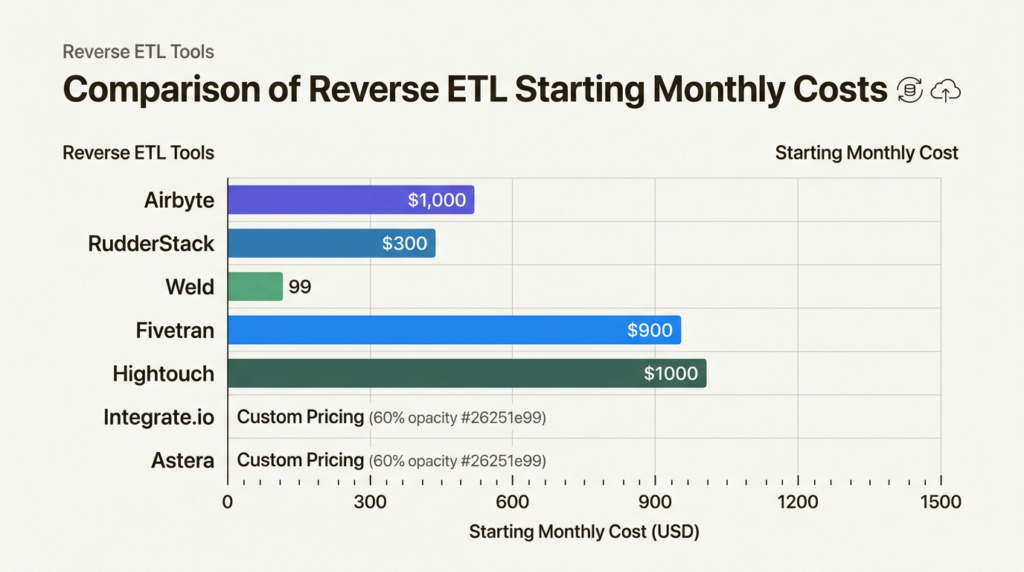
| Tool | Starting Price | Destinations | Best For | Deployment |
|---|---|---|---|---|
| Hightouch | $1,000/mo | 200+ | Broad coverage, SQL teams | Cloud |
| RudderStack | Free/$500/mo | 200+ | Privacy-focused, warehouse-native | Self/Cloud |
| Weld | $99/mo | 300+ | Unified platform, predictable cost | Cloud |
| Fivetran | ~$1,000/mo | 500+ | Enterprise reliability | Cloud |
| Airbyte | Free/$2.50+ | 600+ | Cost-conscious, custom needs | Self/Cloud |
| Integrate.io | Custom | 140+ | Low-code enterprise | Hybrid |
| Astera | Custom | 100+ | Unified data management | Self/Cloud |
Choosing the right Reverse ETL tool for your GTM stack
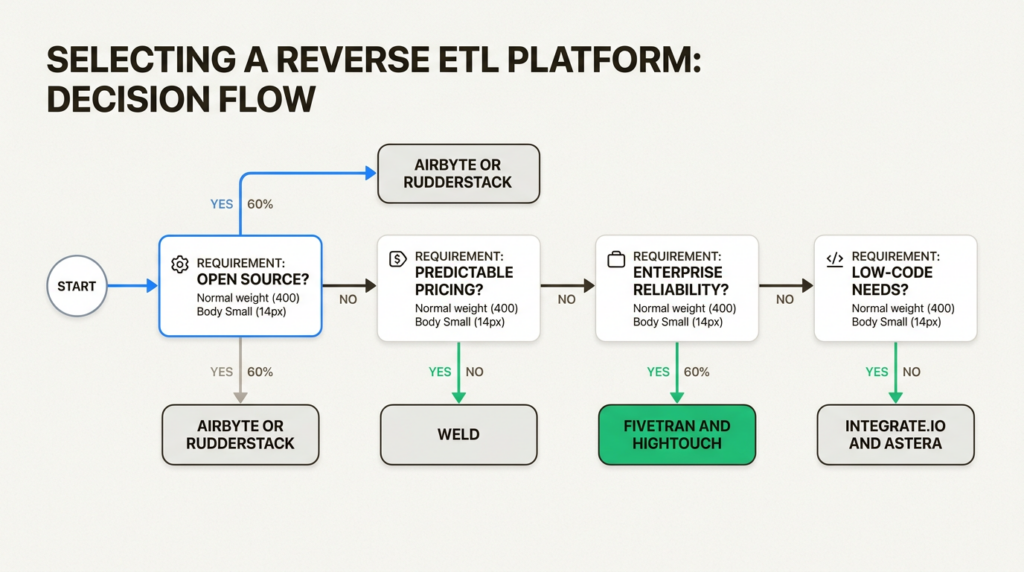
Here’s my take on which tool fits which situation:
Choose Hightouch if: You have dbt workflows and need maximum destination coverage. It’s the safe enterprise choice with the broadest connector library.
Choose RudderStack if: You want a warehouse-native CDP with strong privacy features. The open-source option gives you control without vendor lock-in.
Choose Weld if: You want one platform for ETL + Reverse ETL with predictable subscription pricing. Best value for modern data stacks.
Choose Fivetran if: Reliability and compliance matter more than cost. The 99.9% SLA and automated schema migrations justify the premium for mission-critical pipelines.
Choose Airbyte if: You have engineering resources and want maximum control at minimum cost. The self-hosted option is genuinely free.
Choose Integrate.io if: Your marketing ops team needs low-code workflows and you want a unified platform for multiple data patterns.
Choose Astera if: You want AI-assisted development and unified data management rather than best-of-breed point solutions.
For a broader view of tools that should be in your GTM stack, see our guide to the 20 best GTM tools for 2025.
Implementation tips for GTM Engineers
After setting up Reverse ETL pipelines across multiple platforms, here are the lessons I’ve learned:
- Start with one high-impact use case. Lead scoring sync to Salesforce is a good first project. It demonstrates value quickly and has clear success metrics.
- Validate data quality in your warehouse first. Reverse ETL amplifies whatever data quality issues exist upstream. Garbage in, garbage out applies here too.
- Plan for schema drift. Destination APIs change without warning. Make sure your tool has monitoring and alerting for broken syncs.
- Calculate true cost at 3x current volume. Row-based pricing (MTR/MAR) looks reasonable at small scale but compounds quickly. Model your costs before committing.
- Consider time-to-value. Some tools deploy in hours. Others need weeks of engineering work. Factor this into your evaluation.
Reverse ETL is a key component of how GTM Engineers support AI-driven go-to-market strategies. The data activation layer enables everything from predictive lead scoring to real-time personalization.
Build your warehouse-first GTM engine
Reverse ETL is the activation layer of a modern GTM stack. It bridges the gap between your data team’s work in the warehouse and the operational tools your revenue teams use daily.
The best tool for your team depends on your warehouse maturity, technical resources, and growth stage. Start simple, prove value with one use case, then expand as the business case justifies it.
Avoid stack bloat. The goal isn’t to add another tool, it’s to make your existing data useful where it matters most.
To learn more about the role that manages this stack, read our guide on what a GTM Engineer does and how it fits into modern revenue operations.
Frequently Asked Questions
How does Reverse ETL pricing typically work?
Most tools charge based on Monthly Active Rows (MAR) or Monthly Tracked Rows (MTR). MAR counts only rows that change during the month, while MTR counts every row synced to every destination. One customer record synced to five platforms equals five MTR but only one MAR. Usage-based pricing can spike unexpectedly, so model costs at 2-3x your current volume before committing.
Do I need a data warehouse to use Reverse ETL?
Yes. Reverse ETL assumes you have a central data warehouse (Snowflake, BigQuery, Redshift, or Databricks) with modeled data ready to activate. If you don’t have a warehouse yet, you’ll need to implement one first or consider a traditional ETL tool that includes data storage.
How is Reverse ETL different from traditional ETL?
Traditional ETL extracts data from source systems, transforms it, and loads it into a warehouse for analysis. Reverse ETL goes the opposite direction: it extracts from your warehouse and loads data into operational tools like CRMs and ad platforms. Think of ETL as consolidation for analytics, Reverse ETL as activation for operations.
Can I use Reverse ETL for real-time use cases?
It depends on the tool and your definition of ‘real-time.’ Most Reverse ETL tools offer sync frequencies from batch (hourly or daily) to near real-time (5-15 minutes). True real-time (sub-second) typically requires event streaming infrastructure like Kafka rather than Reverse ETL. For lead routing and ad suppression, near real-time is usually sufficient.
What skills does my team need to implement Reverse ETL?
SQL knowledge is essential for most tools, as you’ll need to write queries or work with dbt models to define what data to sync. Some platforms offer no-code interfaces for simpler use cases. You’ll also need someone who understands your destination systems (Salesforce, HubSpot, etc.) to handle field mapping and troubleshooting.
Leave a Reply