
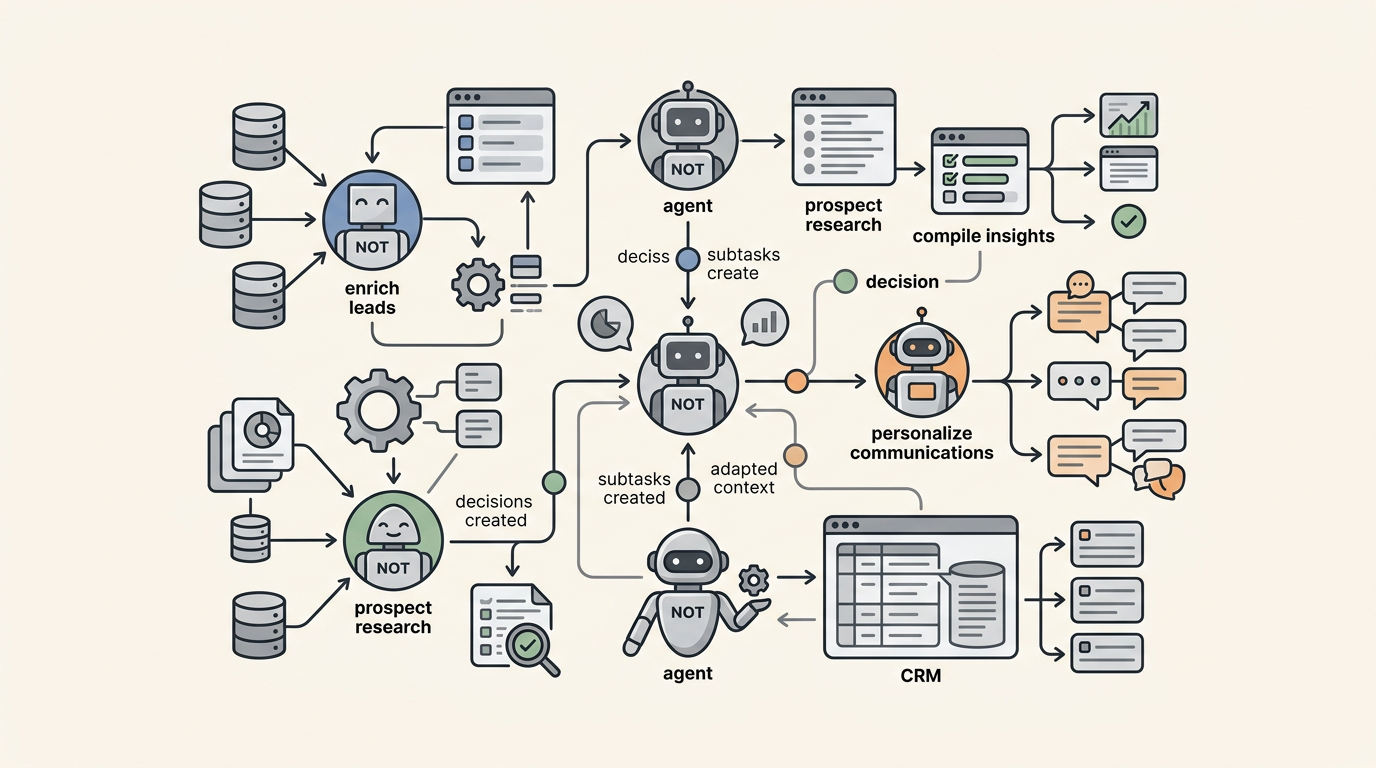
I spent the last few months testing agentic AI tools for GTM workflows. After burning through credits on over a dozen platforms, I’ve narrowed it down to seven that actually deliver on their promises. This guide cuts through the marketing hype and shows you what each tool does well, where it falls short, and who it’s actually for.

What are agentic AI tools (and why GTM teams should care)
Agentic AI tools are autonomous systems that can perceive, reason, and act independently to accomplish goals. Unlike traditional automation with rigid “if this, then that” logic, these agents can break down complex objectives into subtasks, make decisions without constant human input, and adapt their approach based on context.
For GTM teams, this matters because your workflows are rarely linear. A lead comes in, needs enrichment, research, scoring, routing, personalized outreach, follow-up scheduling, and CRM updates. Traditional automation handles this like a checklist. Agentic AI treats it like a project, adjusting when things don’t go as expected.
Gartner predicts 40% of enterprise applications will embed AI agents by 2026, up from under 5% in 2025. The shift is happening fast, and the teams that figure out how to use these tools effectively will have a serious advantage. AI-driven go-to-market strategies are becoming essential for staying competitive.
How we tested these agentic AI tools
I evaluated each tool using real GTM workflows: lead enrichment, prospect research, outbound personalization, CRM hygiene, and competitive monitoring. My criteria focused on what actually matters for RevOps teams:
- Time-to-value: How long from signup to first working automation
- Integration depth: Native connectors vs. workarounds
- Pricing transparency: Can you predict costs or is it a black box
- Reliability: Does it actually run when scheduled
I spent 60+ hours across 15+ tools to narrow this list to seven. The GTM engineer skills and tech stack required to implement these tools varies significantly, which influenced my recommendations.
Comparison at a glance
| Tool | Best For | Starting Price | Key Integration | Top GTM Use Case |
|---|---|---|---|---|
| Gumloop | Non-technical ops | Free ($37 Pro) | Slack | Lead enrichment workflows |
| Claude | Technical teams | Free ($20 Pro) | GitHub | Complex research pipelines |
| n8n | Control-focused teams | Free self-hosted | 400+ nodes | Custom API orchestration |
| Zapier | Existing Zapier users | Free ($19.99 Pro) | 8,000+ apps | Quick automation wins |
| CrewAI | Multi-agent systems | Free (open source) | Python SDK | Research teams |
| Relevance AI | Sales teams | Free ($234 Team) | AI SDR workflows | |
| Kore.ai | Enterprise scale | Custom | 100+ connectors | Cross-department orchestration |
The 7 best agentic AI tools for GTM teams
1. Gumloop
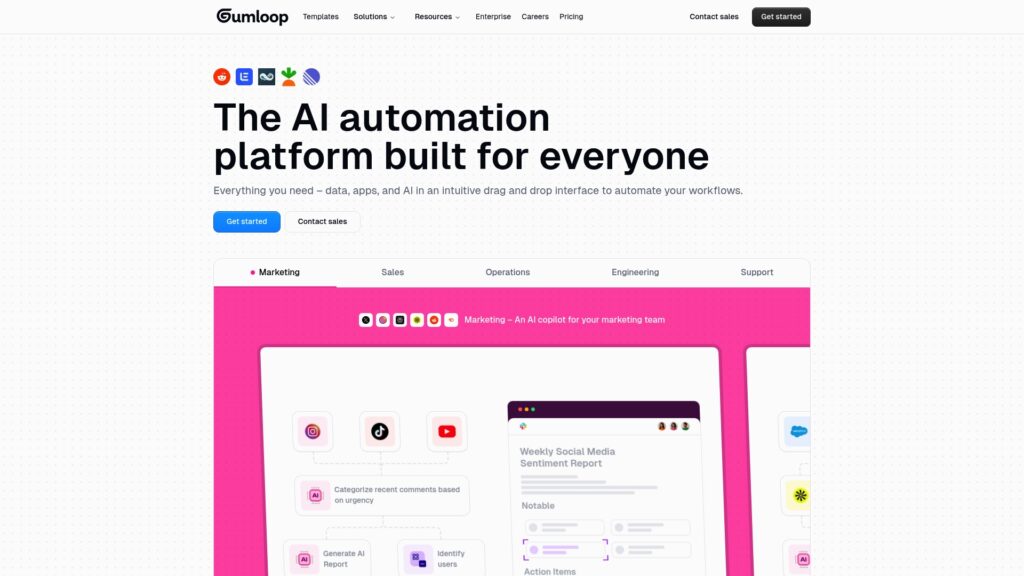
Gumloop is a no-code AI agent builder that lets you create automations through natural language and a visual drag-and-drop interface. It’s the fastest way I’ve found to get an AI agent handling real GTM work without writing code.
What makes it stand out:
- 135+ native nodes covering most popular GTM tools
- One subscription includes all LLM access (no per-model fees)
- Background workflow triggers from apps like Slack
- MCP server support for extending capabilities
GTM use cases:
- Lead enrichment combining Apollo, Clearbit, and CRM data
- Automated outbound with personalized research
- CRM hygiene and duplicate cleanup
- Competitive monitoring from news and social sources
Pricing:
| Plan | Price | Credits | Concurrent Runs |
|---|---|---|---|
| Free | $0 | 5k/month | 2 |
| Pro | $37/mo | 20k+/month | 5 |
| Enterprise | Custom | Custom | Custom |
Pros:
- Fastest time-to-value of any tool on this list
- No API keys needed for LLMs (included in subscription)
- Excellent Slack integration for triggering workflows
- Clean visual builder that’s actually intuitive
Cons:
- Credit system can be opaque (hard to predict costs at scale)
- Limited advanced customization compared to code-based tools
- Enterprise features require sales contact
2. Claude

Anthropic’s Claude isn’t just a chatbot anymore. With Claude Code and Claude Cowork, it’s become a genuine agentic platform for technical teams who want deep customization.
What makes it stand out:
- 200K token context window (can process entire codebases or datasets)
- Claude Code with terminal and browser access for complex tasks
- Claude Cowork for desktop automation (research preview)
- Extended thinking for complex reasoning problems
GTM use cases:
- Complex data analysis and pattern recognition across large datasets
- Custom research pipelines that combine web search, document analysis, and synthesis
- Spreadsheet automation and data transformation
- Policy drafting and compliance document creation
Pricing:
| Plan | Price | Key Features |
|---|---|---|
| Free | $0 | Basic chat, web search, file analysis |
| Pro | $20/mo | Claude Code, Cowork, unlimited projects |
| Team | $25/user/mo | SSO, central billing, admin controls |
| Enterprise | Custom | SCIM, audit logs, HIPAA-ready |
Pros:
- Best reasoning capabilities of any AI model I’ve tested
- Massive context window handles enterprise-scale documents
- Strong safety focus reduces risk of harmful outputs
- Desktop extensions enable true local automation
Cons:
- Requires technical setup to unlock agentic features
- Usage limits on lower tiers can be frustrating
- No native integrations (relies on MCP or API calls)
- Steeper learning curve than visual builders
3. n8n
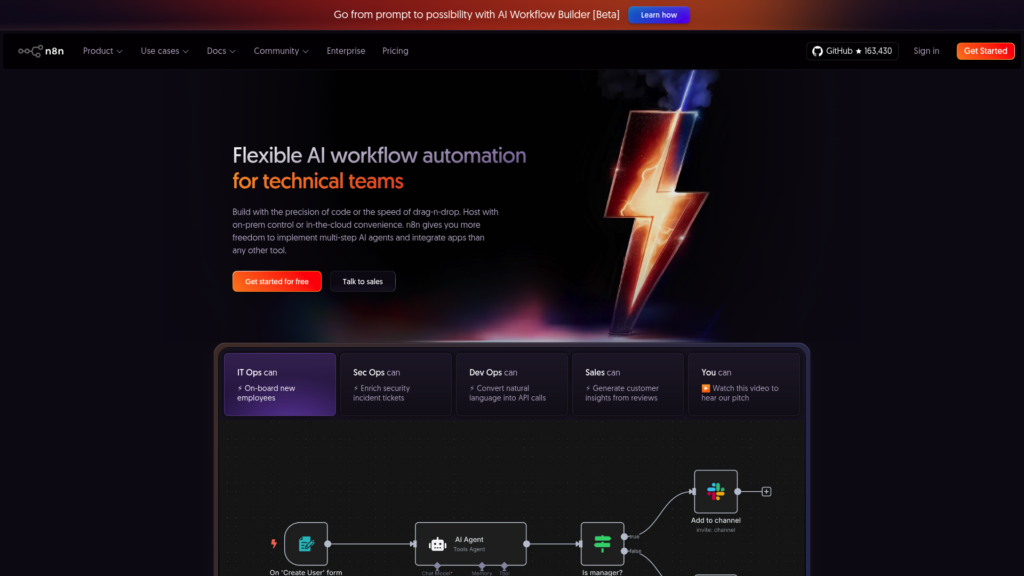
n8n is an open-source workflow automation platform with AI capabilities. It’s the choice for teams who want full control over their data and infrastructure.
What makes it stand out:
- Fair-code license (open source with commercial backing)
- Self-hosted option for complete data control
- 400+ integrations via nodes
- Pay per execution, not per step (unlike Zapier)
GTM use cases:
- Multi-step lead routing with complex conditional logic
- CRM sync between multiple systems (Salesforce, HubSpot, Pipedrive)
- Custom API orchestration for proprietary tools
- Data transformation and ETL workflows
Pricing:
| Plan | Price | Executions | Key Features |
|---|---|---|---|
| Self-hosted | Free | Unlimited | Full control, no limits |
| Starter (cloud) | $20/mo | 2.5K | 1 project, 5 concurrent |
| Pro (cloud) | $50/mo | Custom | 3 projects, 20 concurrent |
| Business | $800/mo | 40K | SSO, Git sync |
Pros:
- Full data control with self-hosted option
- No vendor lock-in (open source)
- Incredibly flexible for complex workflows
- Active community and extensive documentation
Cons:
- Steeper learning curve than visual builders
- Self-hosted requires DevOps overhead
- Cloud pricing jumps significantly at scale
- UI less polished than commercial alternatives
If you’re evaluating alternatives to data enrichment tools, check out our Clay alternatives guide for more options.
4. Zapier
Zapier needs no introduction. It’s the 800-pound gorilla of automation, and their recent AI additions make it worth considering for teams already in the ecosystem.
What makes it stand out:
- 8,000+ app integrations (largest library available)
- Zapier MCP for AI action layers
- Zapier Tables and Forms now included on all plans
- Familiar interface most ops teams already know
GTM use cases:
- Lead capture automation from forms to CRM
- Simple CRM updates and notification routing
- Quick AI-powered workflows without learning new tools
- Connecting disparate systems in legacy stacks
Pricing:
| Plan | Price | Tasks | Users |
|---|---|---|---|
| Free | $0 | 100/mo | 1 |
| Professional | $19.99/mo | 750/mo | 1 |
| Team | $69/mo | 2K/mo | 25 |
| Enterprise | Custom | Custom | Unlimited |
Note: Tasks are counted per action, not per workflow. A 5-step Zap uses 5 tasks per run.
Pros:
- Massive integration library covers almost any tool
- Familiar interface reduces training time
- Quick setup for simple automations
- New AI features are genuinely useful
Cons:
- AI features feel bolted-on rather than native
- Expensive at scale (per-task pricing adds up)
- Less flexible than dedicated agent platforms
- Complex workflows become unwieldy
5. CrewAI
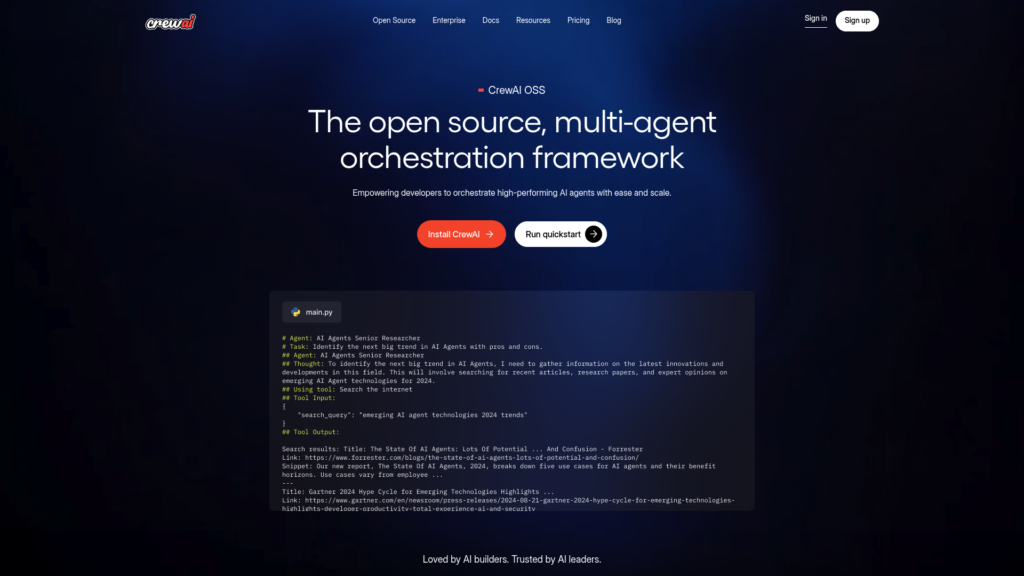
CrewAI is a multi-agent platform built for orchestrating teams of AI agents that collaborate on complex tasks. It’s the most powerful option for teams comfortable with code.
What makes it stand out:
- Multi-agent orchestration with role-based design
- 450M+ agentic workflows run monthly
- 60%+ Fortune 500 adoption
- Both no-code (Studio) and code (API) options
GTM use cases:
- Research teams analyzing market trends across multiple sources
- Content generation pipelines with review and approval workflows
- Multi-step qualification workflows with human handoffs
- Complex data processing requiring multiple specialized agents
Pricing:
| Option | Price | Description |
|---|---|---|
| CrewAI OSS | Free | Open-source framework, self-hosted |
| CrewAI AMP Cloud | Custom | Managed cloud with visual editor |
| CrewAI AMP Factory | Custom | On-prem or private VPC |
Pros:
- Purpose-built for multi-agent collaboration
- Framework-agnostic (works with any LLM)
- Active open-source community
- Enterprise case studies show real ROI
Cons:
- Requires coding knowledge for advanced use
- Documentation has gaps for complex scenarios
- Enterprise pricing requires sales contact
- Visual editor still maturing
6. Relevance AI
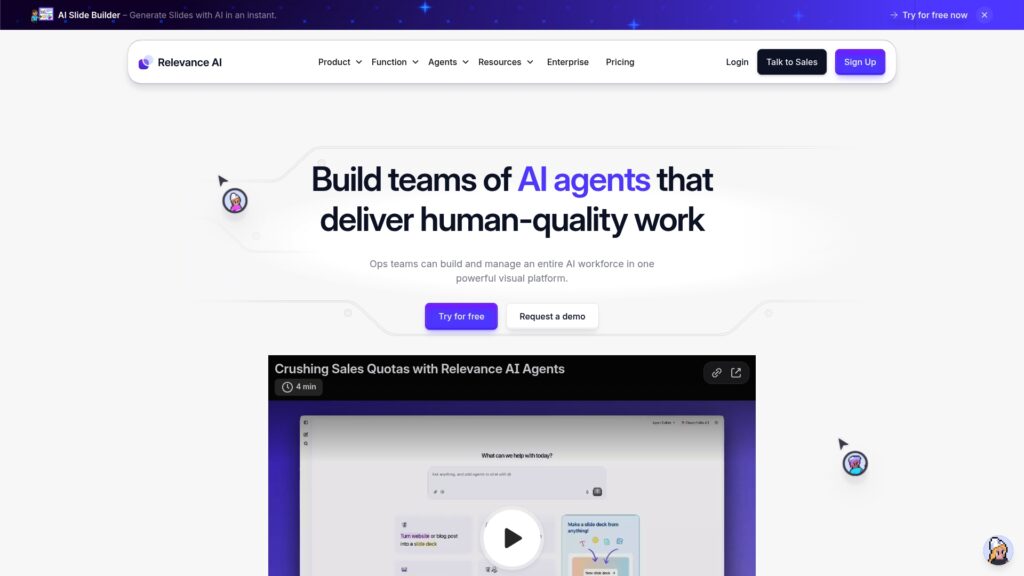
Relevance AI is purpose-built for sales teams wanting AI SDRs and automated outreach. If your primary use case is outbound, this is worth a close look.
What makes it stand out:
- AI SDR agents with dedicated sales workflows
- Multi-channel sequences (email, LinkedIn, calling)
- 2,000+ integrations including strong LinkedIn support
- Meeting booking and calendar integration
GTM use cases:
- Automated prospecting with personalized research
- Multi-touch outbound sequences
- Lead qualification before human handoff
- CRM enrichment and data hygiene
Pricing:
| Plan | Price | Actions | Users |
|---|---|---|---|
| Free | $0 | 200/mo | 1 |
| Team | $234/mo | 7K/mo | 5 build + 45 end |
| Enterprise | Custom | Custom | Unlimited |
Note: Includes vendor credits for LLM usage (1,000 one-time on Free, 35,000/year on Team).
Pros:
- Purpose-built for sales workflows
- Good LinkedIn integration (rare in this space)
- Visual agent builder is intuitive
- Strong focus on measurable outcomes
Cons:
- Limited use cases outside sales
- Pricing jumps significantly for features
- Fewer integrations than general-purpose tools
- Less flexible for non-standard workflows
7. Kore.ai
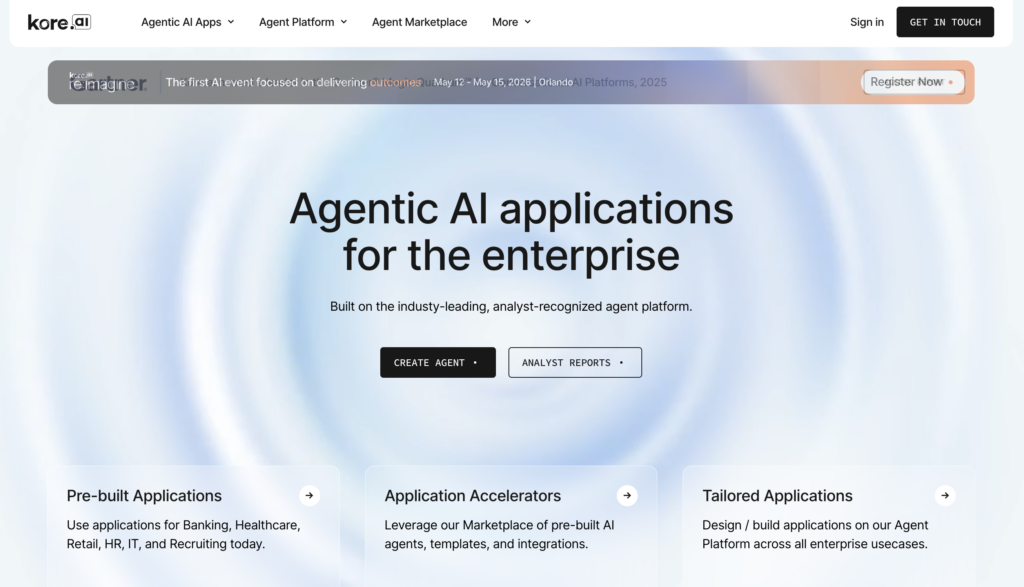
Kore.ai is the enterprise-grade choice for large organizations needing governance, compliance, and scale. It’s overkill for small teams but essential for complex enterprises.
What makes it stand out:
- 300+ pre-built agents and templates
- Multi-agent orchestration with supervisor agents
- 100+ enterprise connectors (SAP, Salesforce, ServiceNow)
- Gartner Magic Quadrant Leader 2025
GTM use cases:
- Enterprise sales automation with compliance requirements
- Cross-department orchestration (sales, marketing, customer success)
- Complex workflows requiring audit trails and governance
- Global deployments with multi-language support
Pricing:
Kore.ai uses custom pricing based on deployment model:
| Component | Pricing Model |
|---|---|
| AI for Work | Per-seat or usage-based |
| AI for Service | Session-based |
| AI for Process | Usage-based with tiers |
| Enterprise Platform | Custom (contact sales) |
Pros:
- Enterprise security and compliance (SOC 2, HIPAA, GDPR)
- Proven at scale with major enterprises
- Flexible deployment (cloud, on-prem, hybrid)
- Strong analyst recognition and validation
Cons:
- Expensive for smaller teams
- Complex setup and implementation
- Sales-led buying process
- Overkill unless you need enterprise features
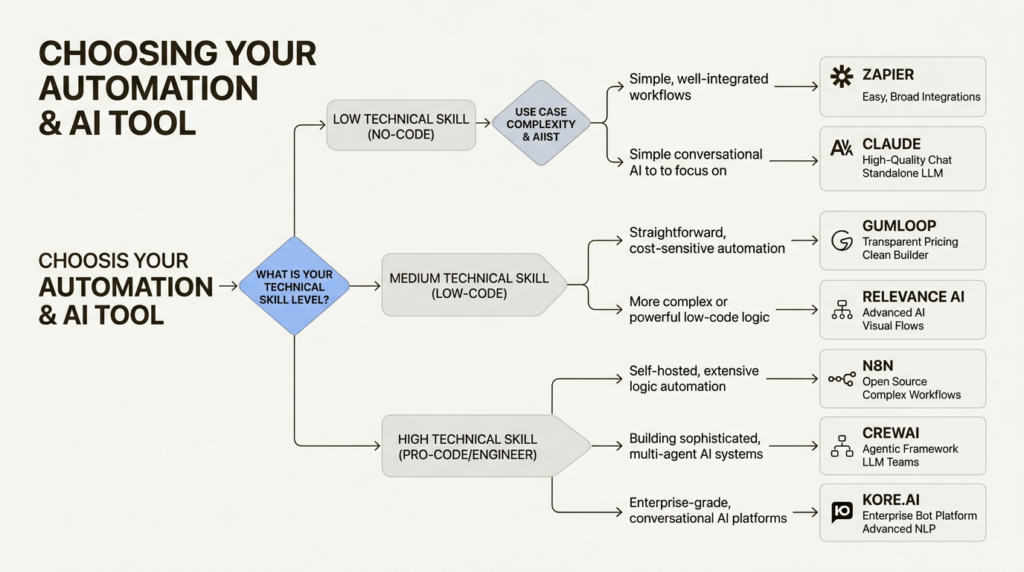
How to choose the right agentic AI tool
Here’s my decision framework based on what I’ve learned testing these tools:
Choose Gumloop if: You’re a non-technical ops person who needs quick wins without engineering help. It’s the fastest path from idea to working automation.
Choose Claude if: You have technical resources and need deep customization. The reasoning capabilities are unmatched for complex analysis tasks.
Choose n8n if: Data control matters to you, or you have DevOps capacity. The self-hosted option is unique among these tools.
Choose Zapier if: You’re already invested in the ecosystem and need AI features on top of existing workflows. The 8,000+ integrations are hard to beat.
Choose CrewAI if: You need true multi-agent collaboration and have Python skills. The open-source framework is powerful in the right hands.
Choose Relevance AI if: Sales is your primary use case and you want purpose-built tools rather than general automation.
Choose Kore.ai if: You’re an enterprise with compliance requirements and need governance at scale. The pre-built agents accelerate deployment.
For more guidance on building your GTM tech stack, see our best GTM tools roundup.
The bottom line: Start with your workflow
After testing all these tools, my advice is simple: don’t overthink it. Start with the tool that fits your current stack and team capabilities.
If you’re new to agentic AI, Gumloop gives you the fastest wins. If you have technical resources, Claude or n8n offer more control. If you’re already on Zapier, their AI features are worth exploring before adding another tool.
The “best” tool is the one your team will actually use. I’ve seen too many teams buy enterprise platforms they never fully implement, or choose open-source tools they don’t have time to maintain.
Pick one tool from this list. Build one workflow that saves you an hour a week. Get that working reliably, then expand. The compound effect of small automation wins beats the perfect tool choice every time.
Want to go deeper on GTM engineering? Learn what a GTM engineer does and how this role is transforming revenue operations.
Frequently Asked Questions
What makes these the best agentic AI tools for GTM teams specifically?
These tools were selected based on real testing with GTM workflows like lead enrichment, prospect research, and outbound automation. Each offers native integrations with CRMs, sales engagement platforms, and data providers that GTM teams actually use.
How do I evaluate which agentic AI tool fits my team’s technical skills?
Start with Gumloop or Zapier if you have no developers. Choose Claude if you have technical users comfortable with APIs. Go with n8n or CrewAI if you have dedicated engineering resources. The learning curve varies significantly between visual builders and code-based platforms.
Can I use multiple agentic AI tools together, or should I pick just one?
Most teams end up using 2-3 tools for different purposes. For example, Gumloop for quick automations, Claude for complex analysis, and your existing CRM’s native AI for simple tasks. The key is avoiding overlap and having clear ownership of each tool.
What’s the typical time-to-value for implementing these agentic AI tools?
Visual builders like Gumloop and Zapier can show results in hours. Claude Code takes a day or two to set up properly. n8n and CrewAI typically require 1-2 weeks for meaningful workflows. Enterprise platforms like Kore.ai often need 1-3 months for full implementation.
How do I measure ROI on agentic AI tools for GTM operations?
Track time saved per workflow, leads processed per hour, and error rates in automated tasks. Most teams see positive ROI when they automate workflows that take more than 2 hours per week. The best metric is often ‘hours returned to sales reps’ for focusing on selling instead of data entry.
What are the hidden costs I should watch out for with agentic AI tools?
Credit-based pricing (Gumloop, Relevance AI) can spike with heavy usage. Per-task pricing (Zapier) adds up faster than expected. LLM API costs (Claude) are separate from platform fees. Always test with realistic volume before committing to annual contracts.
How do these agentic AI tools handle data privacy and security for sensitive GTM data?
Enterprise options like Kore.ai and n8n self-hosted give you full control. Most cloud tools offer SOC 2 and GDPR compliance. For sensitive data, check if the tool trains models on your data (Claude Team/Enterprise doesn’t). Always review data processing agreements before connecting production CRMs.
Leave a Reply