

I burned through $700 in three months on Zapier tasks once. Every webhook, every conditional branch, every data transform counted against my quota. By week six, I was checking the usage dashboard like it was my bank account during a recession.
That’s when I realized Zapier’s task-based pricing punishes you for building sophisticated workflows. For GTM teams running high-volume automations (CRM enrichment, lead routing, territory assignments), the costs scale faster than the value.
So I spent the last quarter testing alternatives. Here are seven that actually make sense for revenue operations in 2026.
Why GTM teams are moving beyond Zapier
Zapier works beautifully for simple automations. The problem starts when your workflows get complex.
Every step in a multi-step workflow counts as a task. A lead routing automation that checks territory, enriches data, assigns to a rep, and logs to your warehouse? That’s four tasks per lead. At 1,000 leads per month, you’re already at 4,000 tasks. Zapier’s Professional plan ($69.99/month) only includes 2,000.
The math gets worse from there.
GTM teams have specific needs that strain Zapier’s model:
- High-frequency triggers (form submissions, webhook events, database changes)
- Multi-step conditional logic (territory routing, lead scoring, enrichment)
- Error handling (retry logic, failure notifications, dead letter queues)
- Data volume (bulk imports, historical syncs, backfills)
For more context on building a complete GTM tech stack, see our guide to the 20 best GTM tools for 2025.
How we evaluated these Zapier alternatives
We tested each platform against criteria that matter for revenue operations:
- Time-to-Value (TTV): How quickly can you build and deploy workflows?
- Total Cost of Ownership (TCO): What does it actually cost at scale?
- GTM use case fit: Does it handle CRM, marketing automation, and sales workflows well?
- Technical depth: API flexibility, error handling, data transformation capabilities
- Integration ecosystem: Native connectors vs. community-built vs. API-based
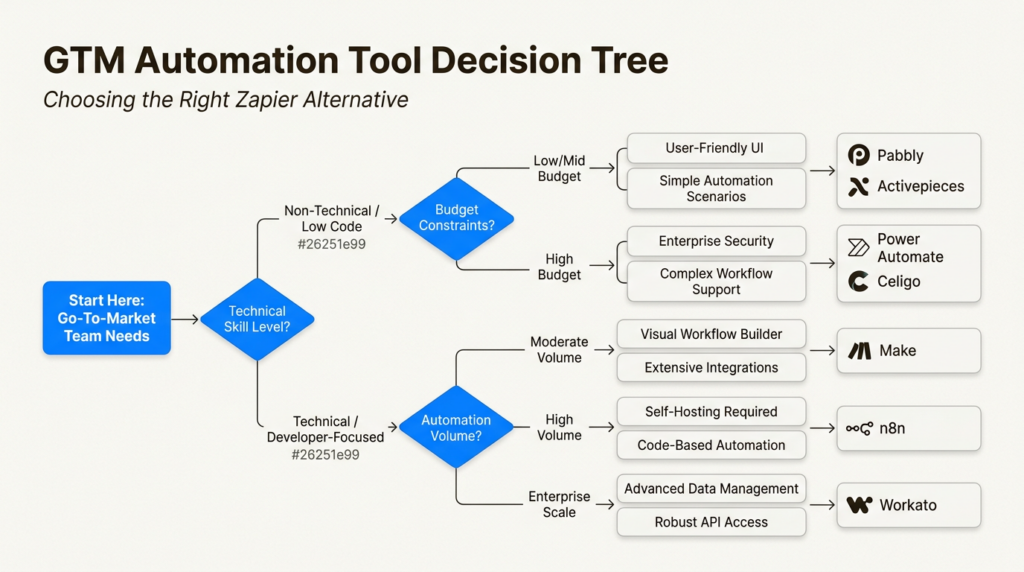
Comparison at a glance
| Tool | Starting Price | Free Tier | Best For | Key Differentiator |
|---|---|---|---|---|
| Make | $9/month | 1,000 ops | Complex workflows | Visual flowchart builder |
| n8n | Free (self-hosted) | Unlimited | Technical teams | Open-source, AI agents |
| Activepieces | $5/flow/month | 10 flows | Budget-conscious | Flat-rate pricing |
| Pabbly Connect | $14/month | 100 tasks | High-volume | Free internal tasks |
| Workato | Custom | Limited | Enterprise | Slack workbots, compliance |
| Celigo | Custom | None | Enterprise iPaaS | AI error management |
| Microsoft Power Automate | $15/user/month | Limited | Microsoft shops | Native M365 integration |
The 7 best Zapier alternatives
1. Make
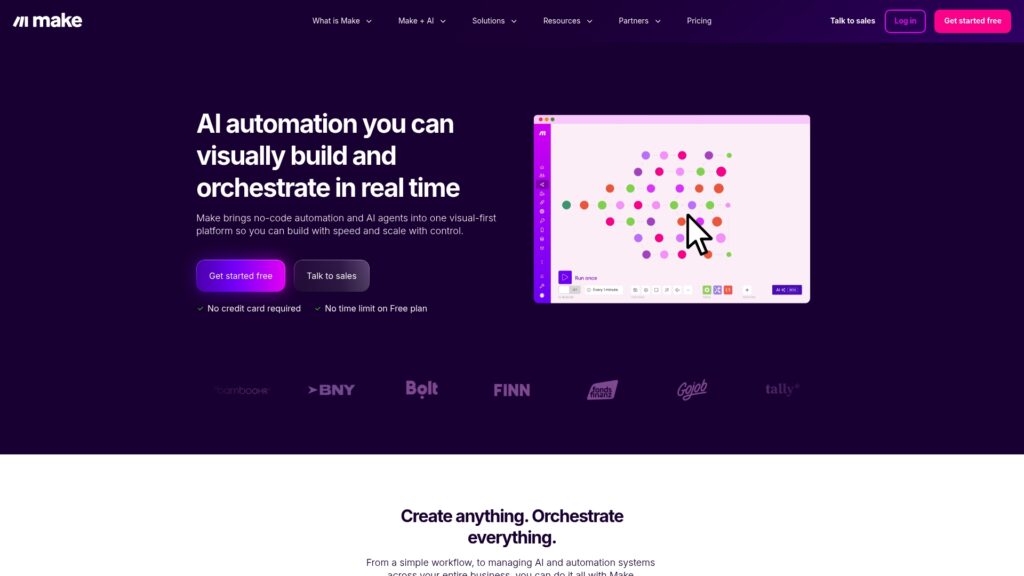
Make (formerly Integromat) is what Zapier should have become. Instead of linear “Zaps,” you build visual flowcharts showing exactly how data moves between applications.
The visual builder handles complexity that would break Zapier. Branching logic, loops, aggregations, and error handling are all visible on the canvas. You can see data transformations at each step.
Pricing: Free for 1,000 operations/month. Paid plans start at $9/month for 10,000 operations. Operations are more granular than Zapier’s tasks (each module action counts as one), but the visual builder often lets you do more with fewer steps.
Key features:
- 3,000+ app integrations including 350+ AI apps
- Visual flowchart builder with real-time execution monitoring
- AI agents, content extraction, and web search built-in
- Custom JavaScript functions for data transformation
- Subscenarios for modular workflow design
Best for: Teams building complex multi-step workflows where visual debugging matters. The learning curve is steeper than Zapier, but the payoff is workflows that would be impossible (or prohibitively expensive) elsewhere.
2. n8n
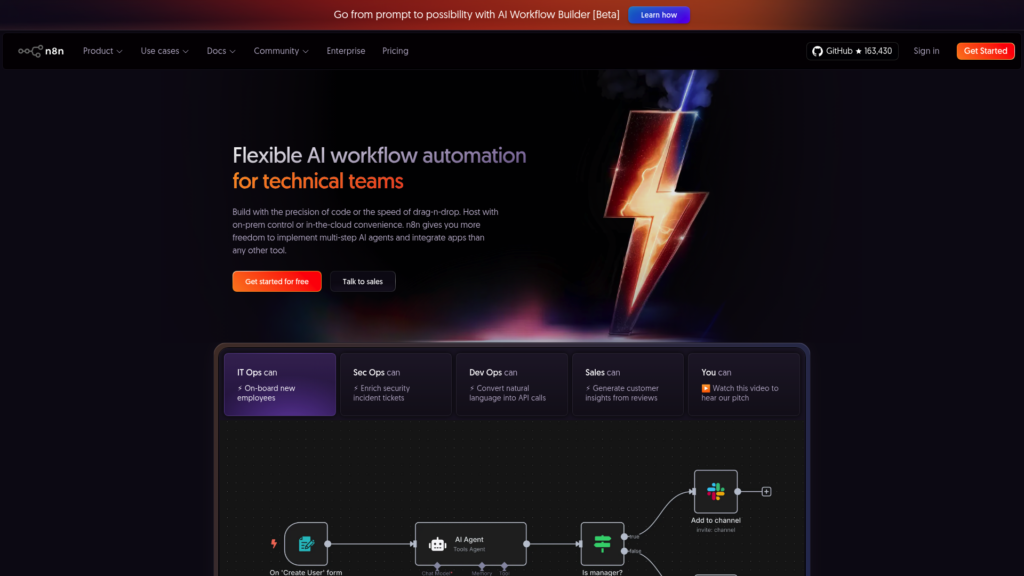
n8n is the choice for technical teams who want complete control. It’s open-source (fair-code license), self-hostable, and charges per workflow execution rather than per step.
Here’s the math that matters: n8n counts one execution as a complete workflow run, regardless of how many steps it contains. A 20-step workflow that runs 100 times costs 100 executions. On Zapier, that’s 2,000 tasks.
The self-hosted Community Edition is free with unlimited executions. For teams needing cloud hosting, plans start at $20/month for 2,500 executions.
Key features:
- 1,000+ integrations (nodes) with 5,000+ templates
- AI Workflow Builder for natural language to workflow generation
- Strong AI agent capabilities with LangChain integration
- Git-based version control for workflows (Business plan)
- JavaScript/Python code execution in workflows
Best for: Technical GTM Engineers comfortable with Docker or npm deployments. The self-hosting requirement adds operational overhead, but you get unlimited scale and complete data sovereignty. For teams building AI-native workflows, n8n’s agent capabilities are hard to beat.
To understand the technical skills needed for this approach, check out our breakdown of skills and tech stacks for GTM Engineers.
3. Activepieces
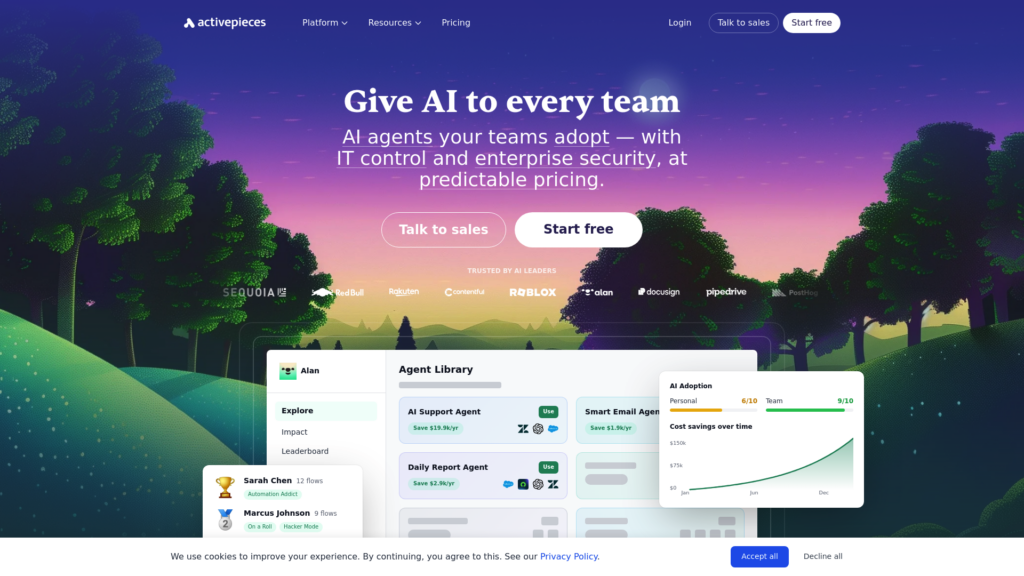
Activepieces is the newest entrant on this list, but it’s growing fastest. The MIT-licensed platform takes a different approach to pricing: you pay per active flow, not per execution.
This matters for high-volume workflows. A lead scoring automation running 10,000 times per month costs the same as one running 100 times. Both are just “one active flow.”
The platform emphasizes AI readiness with native AI agent building and MCP (Model Context Protocol) server support. The “pieces” (integrations) library grows daily through community contributions.
Pricing: Free for 10 active flows. Then $5 per active flow per month. Self-hosted Community Edition is completely free and MIT-licensed.
Key features:
- 634+ pieces (integrations) with daily community additions
- AI agent builder with custom knowledge processing
- MCP server support for Claude and other AI clients
- Unlimited runs per flow (no execution limits)
- TypeScript framework for custom piece development
Best for: Teams wanting open-source flexibility without per-task pricing anxiety. The flat-rate model makes costs predictable even as your automation volume grows.
4. Pabbly Connect

Pabbly Connect wins on raw cost efficiency. The platform’s unique pricing model doesn’t count internal operations toward your task limit. Filters, routers, formatters, iterators, and data transformations are all free.
Only actions that touch external apps count as tasks. A workflow with 5 internal transformations and 1 external API call costs 1 task. On Zapier, that’s 6 tasks.
The platform also offers lifetime deals (one-time payment for permanent access), which is virtually unheard of in SaaS automation.
Pricing: Free for 100 tasks/month. Standard plan at $14/month for 10,000 tasks. Unlimited plan at $59/month. Lifetime deal available at $349 one-time payment.
Key features:
- 2,000+ app integrations
- Free internal tasks (filters, routers, formatters)
- AI Assistant for building intelligent workflow agents
- Email parser for extracting data from incoming emails
- JavaScript and Python code modules
- SOC 2 Type 2 and ISO 27001:2022 certified
Best for: Cost-conscious teams with high-volume internal processing needs. If your workflows involve lots of data transformation before sending to external apps, Pabbly’s pricing model can save thousands annually.
5. Workato
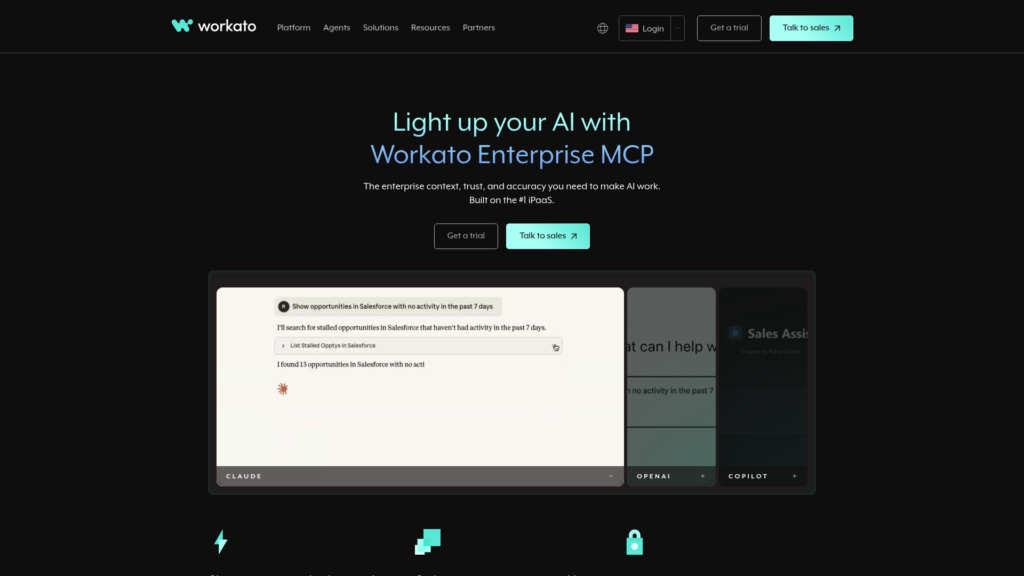
Workato is the enterprise choice. It’s not cheap (custom pricing only), but it handles governance, compliance, and cross-departmental workflows that smaller tools can’t touch.
The platform’s “Workbot” feature integrates directly into Slack and Microsoft Teams, enabling human-in-the-loop approvals. A lead routing workflow can pause for manager approval before proceeding, all within your existing chat tool.
Pricing: Custom pricing based on platform edition and usage. No self-serve option.
Key features:
- 1,000+ connectors with unlimited recipes (workflows)
- Workbot for Slack/Teams-integrated approvals
- AI-powered recipe building (RecipeIQ)
- Full API management and governance
- Enterprise security and compliance controls
- Unlimited collaborators and connections
Best for: Large enterprises with complex governance requirements. If you need SOC 2 compliance, audit trails, and cross-functional workflow collaboration, Workato delivers. For context on how enterprise GTM roles differ, see our comparison of GTM Engineer vs Sales Engineer vs Solutions Engineer.
6. Celigo
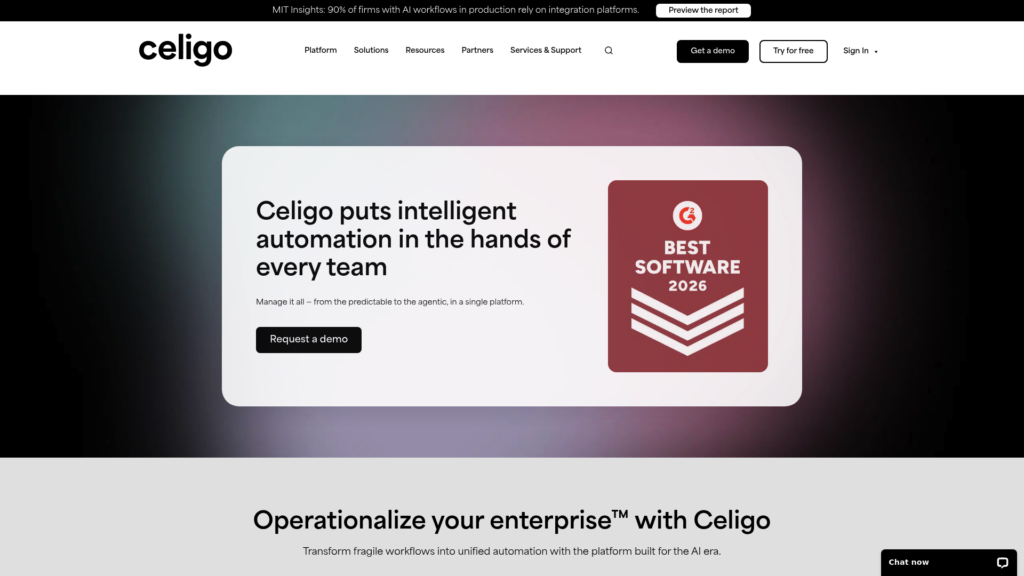
Celigo is an iPaaS (Integration Platform as a Service) rather than a simple automation tool. It’s rated #1 on G2 for iPaaS for seven consecutive quarters, and the AI error management is genuinely differentiated.
The platform automatically resolves 96% of common API errors without human intervention. When a Salesforce API times out or a HubSpot rate limit hits, Celigo retries with exponential backoff, switches endpoints, or queues the request. You get a notification, but the workflow continues.
Pricing: Custom pricing based on endpoints and flows, not tasks or transactions. No overage fees.
Key features:
- AI-powered error management with 96% auto-resolution
- Endpoint-based pricing (predictable costs at any volume)
- Pre-built integration apps for common use cases
- API management and EDI/B2B support
- Customer 360 AI agents
- No overage fees or usage limits
Best for: High-volume operations where reliability matters more than cost. If a failed workflow means lost revenue (order processing, payment reconciliation, inventory sync), Celigo’s error handling justifies the investment.
7. Microsoft Power Automate
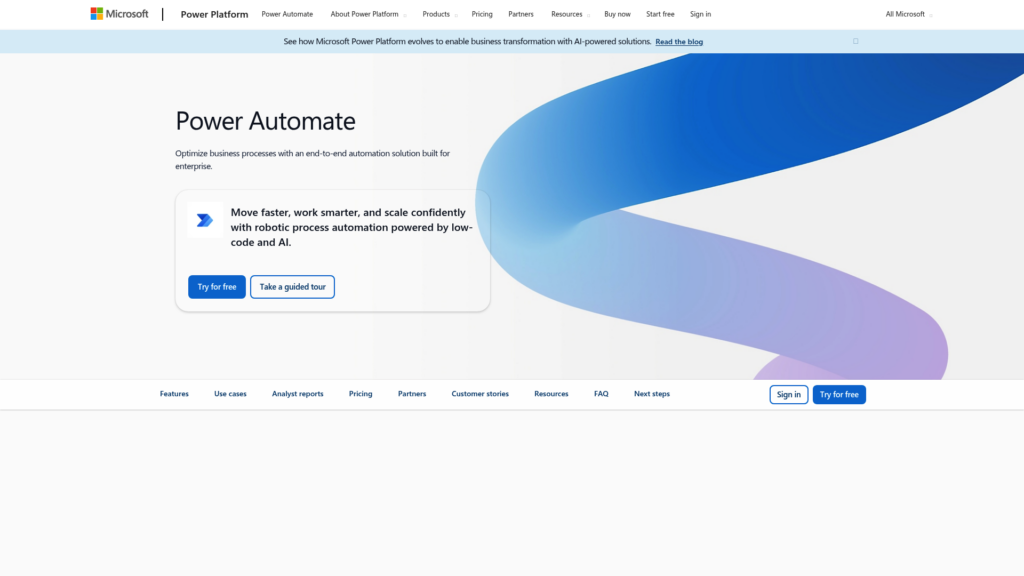
Power Automate is the obvious choice for organizations already invested in Microsoft 365. It’s included (in limited form) with most M365 subscriptions, and the premium tier at $15/user/month unlocks full capabilities.
The platform combines digital process automation (cloud flows) with robotic process automation (desktop flows for legacy systems). The AI Builder add-on brings document processing and prediction capabilities.
Pricing: Free trial available. Premium at $15/user/month. Process (unattended RPA) at $150/bot/month. Hosted Process at $215/bot/month.
Key features:
- Native Microsoft 365, Azure, and Dynamics integration
- Cloud flows (event-triggered) and desktop flows (RPA)
- AI Builder for document processing and predictions
- Process mining and advisor capabilities
- 1,000+ connectors (standard and premium)
- Enterprise governance through Microsoft admin center
Best for: Organizations heavily invested in the Microsoft ecosystem. If your team lives in Outlook, Teams, and SharePoint, Power Automate’s native integration is hard to beat.
Which Zapier alternative should you choose?
The right tool depends on your team’s technical maturity, volume needs, and existing stack.
For complex workflows on a budget: Make. The visual builder justifies the learning curve.
For technical teams wanting control: n8n. Self-host for unlimited free usage, or pay per execution (not per step).
For flat-rate predictability: Activepieces. Pay per flow, not per execution.
For maximum cost savings: Pabbly Connect. Free internal tasks and lifetime deals.
For enterprise compliance: Workato or Celigo. Governance, audit trails, and reliability at scale.
For Microsoft ecosystems: Power Automate. Native integration with M365.
To understand how automation fits into broader AI-driven GTM strategies, read our guide on how GTM Engineers support AI-driven go-to-market strategies.
Start automating your GTM workflows today
The best automation platform is the one your team will actually use. Start with your highest-volume, most painful manual process and test a few alternatives.
Avoid “stack bloat” by choosing tools that integrate with your warehouse-first architecture. If you’re syncing data to Snowflake or BigQuery anyway, consider whether you need a separate automation layer or if your warehouse can handle the orchestration.
For more tooling comparisons, check out our analysis of Clay alternatives. And if you’re building a GTM function from scratch, our guide on what a GTM Engineer does will help you hire the right talent.
Frequently Asked Questions
What are the best Zapier alternatives for small businesses?
For small businesses, we recommend starting with Make ($9/month) for visual workflow building, Pabbly Connect ($14/month) for cost efficiency, or Activepieces (free for 10 flows) for flat-rate pricing. All three offer free tiers to test before committing.
Which Zapier alternative has the best free plan?
n8n’s self-hosted Community Edition is completely free with unlimited workflows and executions. For cloud options, Activepieces offers 10 free flows with unlimited runs, and Make provides 1,000 free operations monthly.
Are there any open-source Zapier alternatives?
Yes. n8n (fair-code license) and Activepieces (MIT license) are both open-source. n8n is more mature with 178,000+ GitHub stars. Activepieces is newer but fully MIT-licensed, allowing modification and redistribution.
What is the cheapest Zapier alternative for high-volume workflows?
Pabbly Connect offers the best value for high volume due to free internal tasks. A workflow with 10 internal transformations and 1 external action costs 1 task on Pabbly vs. 11 tasks on Zapier. The unlimited plan at $59/month is also significantly cheaper than Zapier’s equivalent.
Which Zapier alternative is best for enterprise teams?
Workato and Celigo are the top enterprise choices. Workato excels at human-in-the-loop workflows and Slack integration. Celigo leads on AI error management and reliability. Both offer enterprise governance, SSO, and compliance certifications.
Can I self-host these Zapier alternatives?
Yes. n8n and Activepieces both offer self-hosted options. n8n can run on Docker, npm, or cloud providers. Activepieces provides Docker deployment. Self-hosting gives you unlimited usage and complete data control.
Leave a Reply