

If you’ve ever stared at a job posting wondering whether you need a GTM Engineer, a Sales Engineer, or a Solutions Engineer, you’re not alone. The world of technical revenue roles has become a confusing alphabet soup of overlapping titles and vaguely similar responsibilities.
Here’s the problem: hiring the wrong role for your current challenge is expensive. A GTM Engineer won’t save a deal that’s stalling on technical validation. A Sales Engineer can’t build the automated infrastructure to scale your outbound. And a Solutions Engineer might be overkill if you just need someone to run demos.
At GTM Engineer Club, we’ve spent years running and advising GTM stacks. We’ve seen companies burn months and six-figure salaries on misaligned hires. This guide gives you a practical framework for understanding what each role actually does, when to hire them, and how they work together.
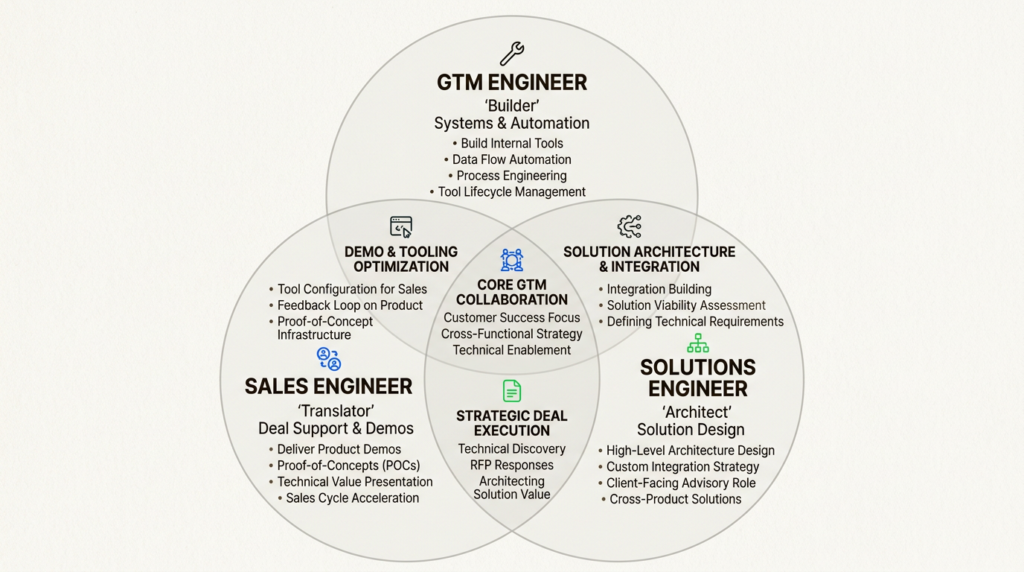
Why GTM Engineer vs Sales Engineer vs Solutions Engineer roles get confused
The confusion starts with how fast these roles have evolved. “Sales Ops” broadened into RevOps as revenue teams demanded cross-functional alignment. “Growth Engineers” turned into GTM Engineers as technical talent shifted from customer-facing product features to internal automation. Meanwhile, Sales Engineers (long the backbone of technical presales) now find themselves pulled into integrations and proof-of-concepts that look suspiciously like ops work.
Add tool sprawl to the mix (CRMs, marketing automation, enrichment providers, product analytics, reverse ETL, CS platforms) and the overlap grows. Early-stage startups often ask one person to wear all three hats, hacking together workflows in the morning, cleaning pipeline definitions in the afternoon, and joining customer demos at night. As a company scales, those blended responsibilities get split into distinct hires.
The GTM Engineer vs Sales Engineer vs Solutions Engineer distinction matters because each role solves a fundamentally different problem. Get it wrong, and you’ll have a frustrated employee who can’t impact the metrics they’re being measured against.
GTM Engineer: The builder
A GTM Engineer is the technical operator who designs and automates revenue systems. They emerged around 2023 as companies recognized that traditional go-to-market tactics had become commoditized. When every AI product category has reached saturation and prospects receive hundreds of generic cold emails daily, you need someone who’ll build systems that cut through the noise.
Core responsibilities:
- Build lead qualification workflows that reduce qualification time from hours to minutes
- Develop multi-step outbound campaign automation with AI-powered personalization
- Implement sales trigger systems that react to buying signals in real-time
- Orchestrate tech stacks by connecting CRMs, marketing automation, enrichment tools, and analytics platforms into one coherent system
- Create scalable demo environments that serve as proof-of-concept for prospects
Technical toolkit:
- SQL, Python, APIs, webhooks
- Data warehouses like Snowflake or Postgres
- Reverse ETL tools such as Hightouch or Census
- Automation platforms like Tray, Workato, or Zapier
Where they sit: GTM Engineers are most often embedded within Growth, Revenue Operations, or Product teams. In early-stage companies (sub-$10M ARR), they’re typically a first “ops engineer” hire, reporting directly to a Head of Growth or COO.
The outcome: Individual GTM Engineers can generate hundreds of qualified meetings per month through systematic automation. They work across sales, marketing, and customer success to provide automated account research, surface key data that pushes deals forward, and ensure customers extract maximum value from the platform through automated engagement.
Learn more about what a GTM Engineer does and the skills and tech stack required.
Sales Engineer: The translator
A Sales Engineer is the technical expert who bridges product capabilities and customer needs during sales cycles. They translate the system’s outputs into a compelling customer narrative. When your Account Executive’s hitting a wall on technical objections, the Sales Engineer steps in at the moment of truth.
Core responsibilities:
- Technical discovery and needs analysis to understand a prospect’s environment
- Product demonstrations and proof-of-concepts that show the product working in the customer’s context
- Technical objection handling during late-stage sales conversations
- RFP/RFI responses that address security, compliance, and integration questions
- Supporting Account Executives on deals that require technical validation
Technical toolkit:
- Demo environments and sandboxes
- API clients like Postman
- Deep product expertise
- Presentation and storytelling skills
Where they sit: Sales Engineers live squarely within Sales. Their reporting line is usually to a VP of Sales or CRO, and their day-to-day accountability’s tied directly to supporting AEs in live opportunities.
The SE-to-AE ratio:
- Enterprise models: 1 SE for every 2-3 AEs
- Velocity-driven sales: 1 SE supporting 5-10 AEs
The outcome: Prospects move forward not because they were told the product works, but because they’ve seen it work in their own context. Sales Engineers drive deal confidence.
Solutions Engineer: The architect
A Solutions Engineer is a technical presales role focused on solution design and architecture. Here’s the thing: in practice, the terms “Solutions Engineer” and “Sales Engineer” are often used interchangeably. The decision to call the team members one versus the other is purely a leadership decision.
That said, when companies do distinguish between them, here’s how the roles typically differ:
Core responsibilities:
- Solution architecture design that maps customer requirements to technical implementation
- Complex integration planning across multiple systems
- Technical documentation including diagrams, data flows, and API mappings
- Post-sales implementation handoff to ensure continuity
- Long-term customer success alignment
How it differs from Sales Engineer:
- Greater emphasis on architecture versus demos
- Often spans pre-sales through post-sales implementation
- More consultative, less transactional
- May report to Professional Services or Solutions Architecture rather than pure Sales
When companies use “Solutions” versus “Sales”:
- “Solutions Engineer” emphasizes problem-solving and aligns with modern SaaS culture
- “Sales Engineer” is traditional and clearly indicates revenue team alignment
- Often interchangeable, job description matters more than title
As Kerry Hew from Zycada Networks noted: “For the most part, the terms are synonymous and the decision to call the team members one vs the other is purely a leadership decision.”
GTM Engineer vs Sales Engineer vs Solutions Engineer: The comparison matrix
Let’s put all three roles side by side:
| Dimension | GTM Engineer | Sales Engineer | Solutions Engineer |
|---|---|---|---|
| Focus | Systems & automation | Individual deals | Solution architecture |
| Scope | Full GTM motion | Pre-sales technical support | Pre through post-sales |
| Primary output | Automations, integrations | Technical enablement per deal | Architecture docs, implementation plans |
| Engagement | One-to-many (systems for org) | One-to-one (per deal) | One-to-one (deals + implementations) |
| Technical depth | SQL, APIs, data pipelines | Product + demo expertise | System architecture, integrations |
| Success metrics | Pipeline velocity, efficiency | Win rates, deal support | Implementation success, time-to-value |
| Reporting | Growth/RevOps/Product | Sales leadership | Sales or Professional Services |
Key insight: GTM Engineers build the infrastructure that captures and routes signals efficiently. Sales Engineers step in at the moment of truth, translating the system’s outputs into a compelling customer narrative. Solutions Engineers span both worlds with deeper architectural focus.
When to hire which role
The right time to hire depends on the bottleneck you’re trying to solve.
Hire a GTM Engineer when:
- You’ve achieved product-market fit but lack scalable outbound systems
- Your sales team spends more time managing disconnected tools than selling
- Multiple GTM tools exist, but no one has unified them into a cohesive workflow
- Lead response times stretch into hours or days
- Inconsistent data leads to poor decision-making
Learn more about how GTM Engineers support AI-driven go-to-market strategies.
Hire a Sales Engineer when:
- You’re selling into enterprise accounts with technical stakeholders
- Your sales team struggles to navigate technical conversations
- Prospects want proof of model performance, integrations, and data readiness
- Deals stall at proof-of-concept or technical validation
Explore GTM Engineer jobs to see how these roles fit into modern revenue teams.
Hire a Solutions Engineer when:
- Complex integrations are core to your value proposition
- Customers require custom architecture design
- Post-sales technical continuity is critical
- You need someone to span sales and implementation handoffs
By company stage:
- Pre-$10M ARR: One technically inclined person may wear parts of all three hats
- $10M-$50M ARR: Specialization begins. Consider a GTM Engineer for scale, Sales Engineers for enterprise deals
- $50M+ ARR: All three roles likely needed with clear boundaries and reporting lines
Salary and career considerations
Salary ranges (2026):
| Role | Entry (0-2 years) | Mid (3-5 years) | Senior (6+ years) |
|---|---|---|---|
| GTM Engineer | $78K-$95K | $95K-$108.5K | Up to $128K |
| Solutions Engineer | $80K-$120K | $120K-$180K | $180K-$280K |
| Sales Engineer | ~5% lower than Solutions Engineer | ~3% lower | ~2% lower |
Sources: ZipRecruiter, DemoToDeals 2026 market data
Career progression:
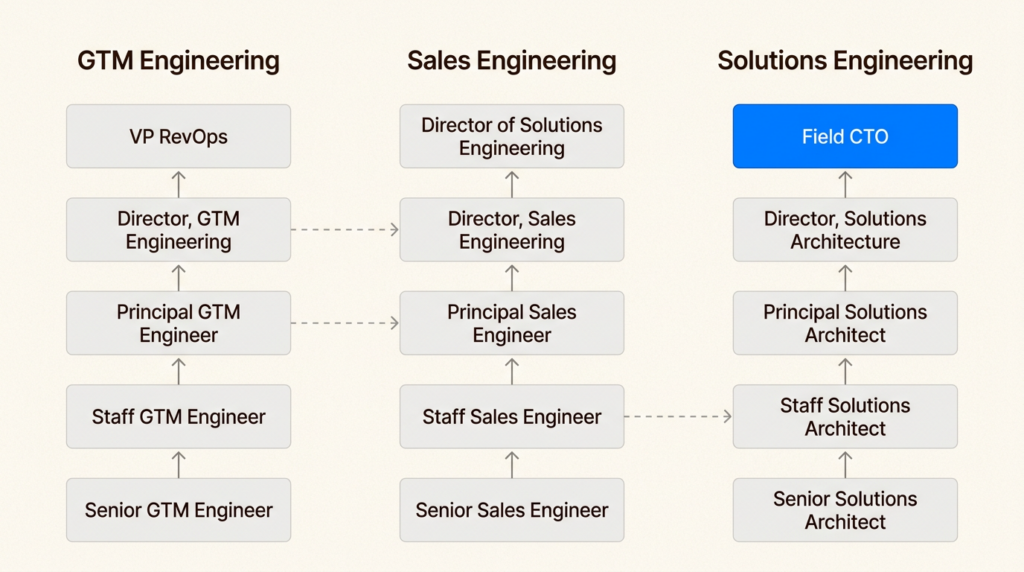
- GTM Engineer: Senior GTM Engineer → Head of GTM Engineering → VP Revenue Operations
- Sales Engineer: Senior SE → Principal SE → Director of Solutions Engineering
- Solutions Engineer: Senior Solutions Engineer → Solutions Architect → Field CTO
Transition paths:
Moving between these roles is increasingly common as the lines blur. SEs transitioning to GTM Engineering need to add automation and data skills. GTM Engineers moving to SE roles need to develop customer-facing and demo skills. Both paths are valuable as AI reshapes how revenue teams operate.
For detailed salary data, see our GTM Engineer salaries guide.
How AI is changing these roles
AI doesn’t replace presales expertise; it amplifies it. From faster knowledge access and automated drafting to predictive win analysis, AI lets technical revenue professionals spend less time formatting and more time on strategy.
GTM Engineers are now orchestrating AI agents for prospecting, enrichment, and outreach. They’re building the infrastructure that lets AI BDRs operate at scale while maintaining quality.
Sales Engineers use AI for faster knowledge access, automated proposal drafting, and predictive win analysis. The technical win, while still important, has become secondary to ensuring that your solution maps to key business initiatives.
Solutions Engineers leverage AI-assisted architecture design and automated documentation. They’re spending less time on diagrams and more time on strategic solution planning.
The shift is from “technical wins” to “business outcome mapping.” All three roles are evolving toward hybrid skill sets that combine system-building with customer-facing capabilities.
Learn more about AI lead generation and how it’s transforming these roles.
Making the right choice for your team
So which one do you need? Let’s break it down.
The real question isn’t “which title?” but “what problem are you solving?”
- Infrastructure problem (scaling systems, automation, data flow) → GTM Engineer
- Deal support problem (technical validation, demos, objections) → Sales Engineer
- Complex implementation problem (architecture, integrations, post-sales continuity) → Solutions Engineer
At GTM Engineer Club, we’ve built resources to help you navigate these decisions. Whether you’re hiring your first technical revenue role or scaling an existing team, understanding these distinctions is the difference between building a revenue engine that hums and one that sputters.
Explore our guides on the best GTM tools for 2025 and Clay alternatives to build your technical revenue stack.
Frequently Asked Questions
Can one person do all three roles?
At early-stage companies (sub-$10M ARR), one technically inclined person often wears parts of all three hats. But as you scale, the roles diverge. Trying to have one person build infrastructure, run demos, and design architecture leads to burnout and mediocre results across the board.
Which role pays the most?
Senior Solutions Engineers typically command the highest salaries ($180K-$280K), followed by GTM Engineers at senior levels ($128K+). However, compensation varies significantly by company stage, location, and equity packages. Sales Engineers often have more variable comp tied to deal performance.
Should I hire a GTM Engineer or a Sales Engineer first?
If you’re pre-$10M ARR and selling to technical buyers, start with a Sales Engineer to close deals. Once you have product-market fit and need to scale, add a GTM Engineer to build the infrastructure that feeds those deals.
What’s the difference between a Solutions Engineer and a Sales Engineer?
In most companies, the terms are used interchangeably. When distinguished, Solutions Engineers tend to focus more on architecture and may span pre-sales through post-sales, while Sales Engineers focus on deal support within the sales cycle.
Can a Sales Engineer become a GTM Engineer?
Yes, and vice versa. The transition requires adding skills: SEs moving to GTM Engineering need SQL, API, and automation expertise. GTM Engineers moving to SE roles need to develop presentation skills and deep product knowledge.
How do I know if I need a GTM Engineer vs Sales Engineer vs Solutions Engineer?
Audit where your deals are getting stuck. If it’s technical validation during sales cycles, you need a Sales Engineer. If it’s scaling your outbound or unifying your tools, you need a GTM Engineer. If it’s complex implementation architecture, you need a Solutions Engineer.
Leave a Reply