
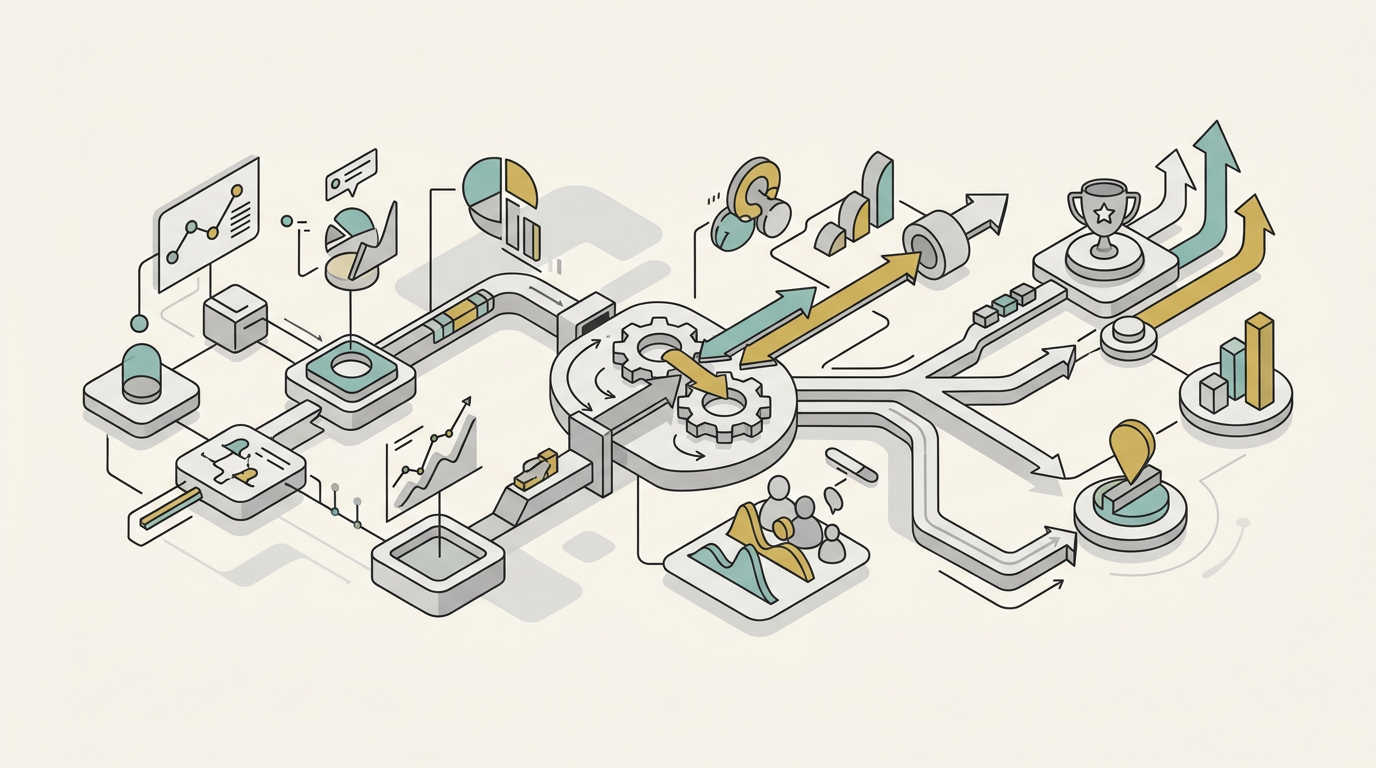
The difference between product launches that fizzle and those that scale often comes down to one thing: a solid go-to-market strategy. In 2026’s hyper-competitive B2B landscape, having a great product isn’t enough. You need a systematic approach to get it into the right hands, at the right time, through the right channels.
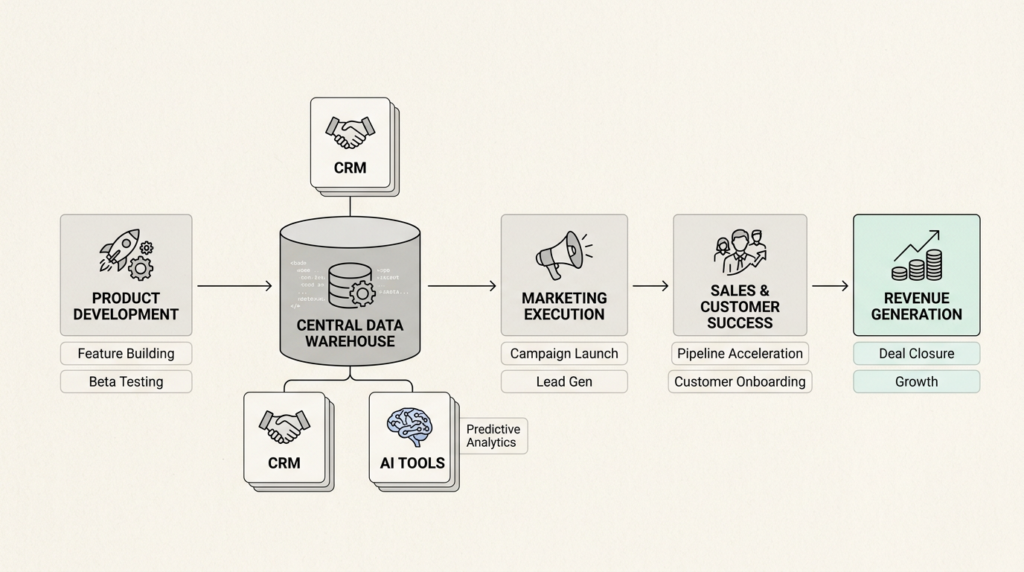
Traditional GTM playbooks weren’t built for the modern revenue stack. They don’t account for warehouse-first data architectures, AI-powered sales enablement, or the technical complexity that now underpins every successful launch.
This guide bridges that gap. We’ll cover the frameworks that still matter, the components every GTM strategy needs, and the technical execution layer that separates good GTM from great GTM. Whether you’re launching your first product or refining an existing motion, this is the practical guide revenue teams need in 2026.
What is a GTM strategy?
A go-to-market (GTM) strategy is a comprehensive plan for bringing a product or service to market. It outlines how you’ll reach target customers, deliver your value proposition, and gain competitive advantage. Think of it as the bridge between product development and revenue generation.
You’ll need a GTM strategy when:
- Launching a new product in an existing market
- Entering a new market with an existing product
- Expanding into new regions or verticals
- Testing a new product concept
- Pivoting your business model
The 2026 context makes GTM more complex than ever. Buyers research independently through AI-powered search. Sales cycles involve an average of 11 stakeholders. Customer data lives across dozens of tools. And expectations for personalized, seamless experiences have never been higher.
Here’s the distinction that trips up a lot of teams. A GTM strategy covers the full process of bringing a product to market, including sales, distribution, pricing, and customer support. It’s typically focused on a specific launch or market entry. Your marketing strategy, on the other hand, is ongoing and focuses specifically on demand generation and brand communication. The GTM strategy includes marketing, but marketing doesn’t include GTM.
The GTM Engineer: Why technical execution matters
There’s a new role emerging in high-growth companies: the GTM Engineer. This isn’t just a fancy title for someone who knows their way around Salesforce. It’s a hybrid technical-business function that bridges the gap between strategy and execution.

GTM Engineers code. They write SQL to segment audiences, Python to automate workflows, and JavaScript to build custom integrations. But they also understand CAC, LTV, and funnel velocity. They speak both languages fluently.
Modern GTM requires data orchestration, automation, and API fluency. When your ICP data lives in Snowflake, your product usage data is in Amplitude, and your sales team lives in Salesforce, someone needs to connect those dots. That someone is the GTM Engineer.
The gap they fill is real. Most GTM strategies fail not because the strategy was wrong, but because the execution layer couldn’t support it. Data didn’t flow. Automations broke. Reports took weeks to generate. By the time insights surfaced, the opportunity had passed.
Warehouse-first data strategies matter because they give you a single source of truth. Instead of syncing data between 15 different tools (and dealing with the inevitable drift and conflicts), you centralize everything in your data warehouse and push clean, consistent data back out. This is what Reverse ETL enables, and it’s becoming table stakes for serious GTM operations.
Core components of a winning GTM strategy
Every GTM strategy needs certain foundational elements. Here’s what matters most, organized by functional area.
Market analysis and ICP definition
Before you sell anything, you need to know who you’re selling to. This starts with TAM/SAM/SOM calculations:
- TAM (Total Addressable Market): Everyone who could theoretically buy your product
- SAM (Serviceable Addressable Market): The portion you can actually reach given your constraints
- SOM (Serviceable Obtainable Market): What you can realistically capture in the near term

Your Ideal Customer Profile (ICP) should go deeper than firmographics. What tech stack do they use? What workflows are they trying to improve? What triggers indicate they’re ready to buy? The best ICPs include both qualitative insights (from customer interviews) and quantitative signals (from product usage and engagement data).
Value proposition and positioning
Your value proposition needs to answer one question: why should customers choose you over alternatives? This requires understanding not just your strengths, but your competitors’ weaknesses.
Positioning is about context. Where do you fit in the competitive landscape? Are you the premium option with enterprise features? The lightweight alternative for small teams? The technical solution for developers? Your positioning should be defensible and differentiated.
Pricing and packaging
Pricing strategy directly impacts unit economics and market positioning. Common models include:
| Model | Best For | Example |
|---|---|---|
| Subscription | Predictable revenue, ongoing value | $49/user/month |
| Usage-based | Variable consumption patterns | $0.01 per API call |
| Tiered | Different user segments | Free / Pro / Enterprise |
Packaging decisions matter too. What features go in which tier? Do you offer a free trial or freemium? Adobe’s shift from perpetual licenses to Creative Cloud subscriptions is a classic example of packaging strategy driving business transformation.
Distribution and channels
How will customers discover and purchase your product? Options include:
- Direct sales: Your team sells directly to customers
- Self-serve: Customers sign up and buy without sales involvement
- Channel partners: Resellers, system integrators, or referral partners
- Marketplaces: AWS Marketplace, Salesforce AppExchange, etc.
Most B2B companies use a mix. The question is which motion drives the majority of your revenue and how the channels complement each other.
Metrics and KPIs
You can’t improve what you don’t measure. GTM metrics fall into two categories:
Leading indicators (predict future performance):
- Pipeline velocity
- Engagement rates
- Demo requests
- Product-qualified leads (PQLs)
Lagging indicators (show historical results):
- Customer Acquisition Cost (CAC)
- Lifetime Value (LTV)
- CAC payback period
- Net Revenue Retention (NRR)
Your North Star metric should align with your primary growth motion. PLG companies often focus on activation rate. SLG companies track sales cycle length and win rates.
The three GTM motions: PLG, SLG, and hybrid
Not all GTM strategies work the same way. The three primary motions suit different products, markets, and company stages.
Product-led growth (PLG)
In PLG, the product itself drives acquisition and expansion. Users discover the product, sign up for free, experience value, and convert to paid without ever talking to sales.
PLG works best for:
- Self-serve tools with low time-to-value
- Products where users can experience value independently
- Markets with bottom-up adoption patterns
Key metrics include activation rate (users who experience core value), PQL conversion (free to paid), and expansion revenue (existing customers buying more).
Sales-led growth (SLG)
SLG relies on sales reps to drive deals through demos, proposals, and negotiations. This is the traditional enterprise sales model.
SLG works best for:
- Complex solutions requiring implementation
- High-ACV deals with multiple stakeholders
- Markets where buyers expect white-glove treatment
Key metrics include SQL conversion, average contract value (ACV), and sales cycle length.
Hybrid approaches
Most companies end up with some combination. You might use PLG for initial adoption and SLG for enterprise expansion. Or SLG for initial deals with PLG features for ongoing engagement.
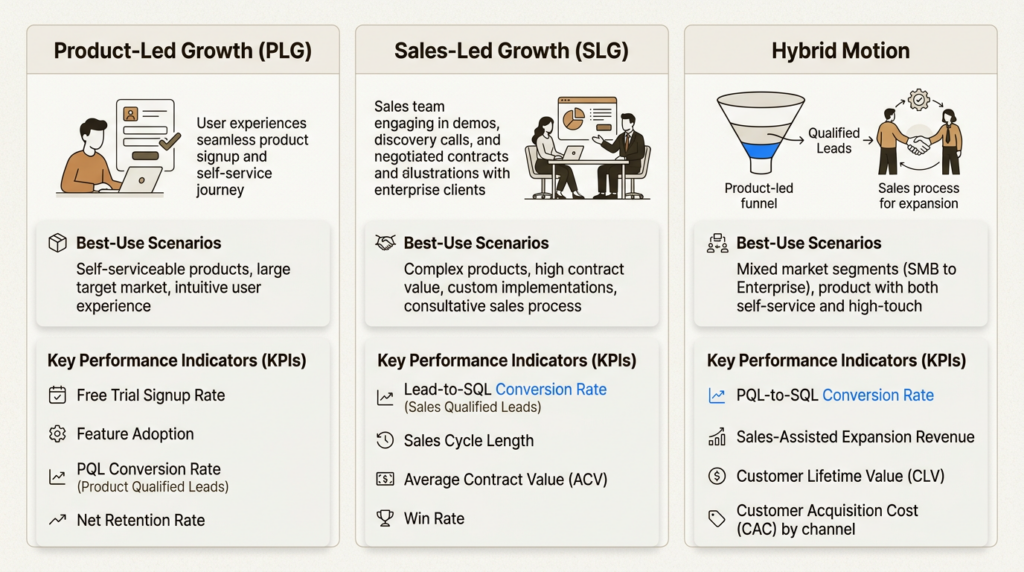
The orchestration challenge is real. When does a product-qualified lead get passed to sales? How do you prevent channel conflict? What happens when a self-serve user suddenly needs enterprise features? These handoffs need clear rules and clean data.
Building your GTM tech stack
The modern GTM stack has evolved. Here’s what you need to know about the core categories:
CRM: Your system of record for customer relationships. Salesforce dominates enterprise. HubSpot owns the mid-market. Newer players like Attio are rethinking CRM from a data-first perspective.
Customer Data Platform (CDP): Collects and unifies customer data from multiple sources. Critical for understanding the complete customer journey.
Reverse ETL: Pushes warehouse data back into operational tools. This lets you use SQL-defined segments in your email tool, enrichment data in your CRM, and product usage signals in your sales engagement platform.
Sales Engagement: Tools like Outreach and Salesloft automate and optimize sales communications.
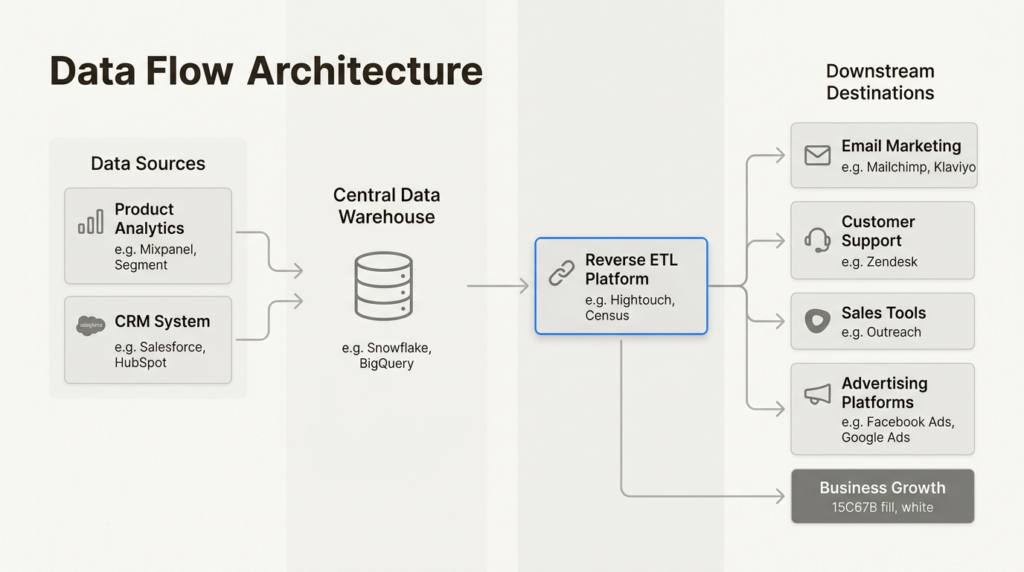
When evaluating tools, consider Time-to-Value (TTV). How long until you’re getting value? A tool that takes six months to implement might have great features, but the opportunity cost is real.
Integration complexity is often underestimated. Every new tool needs to talk to your existing stack. Before adding another tool, map the data flows. What needs to sync? How often? What happens when syncs fail?
Stack bloat is a real problem. According to research from Highspot, GTM execution fails when distribution channels aren’t coordinated and feedback loops between departments break down. Sometimes the best tool decision is not adding another tool.
Common GTM mistakes (and how to avoid them)
After analyzing dozens of GTM strategies, certain failure patterns emerge:
Mistake 1: Launching without product-market fit validation
You can have a well-crafted GTM strategy for a product nobody wants. Validate PMF before scaling GTM investment. Signals include organic word-of-mouth, low churn, and expansion revenue from existing customers.
Mistake 2: Underestimating data infrastructure needs
GTM runs on data. If your data is siloed, stale, or inconsistent, your strategy will suffer. Invest in data infrastructure early. The companies that get this right treat data as a product, not an afterthought.
Mistake 3: Siloed sales and marketing teams
When sales and marketing operate independently, you get disjointed customer experiences and wasted spend. Alignment requires shared goals, regular communication, and integrated tooling. Zendesk’s research shows that 85% of CX leaders believe customers will drop brands over unsatisfactory experiences. Consistency is essential.
Mistake 4: Ignoring post-launch iteration
GTM isn’t “set and forget.” Markets change. Competitors react. Customer needs evolve. Build feedback loops into your strategy from day one. Quarterly reviews led by RevOps are critical to catch shifting patterns before they become problems.
2026 GTM trends: AI, automation, and data
The GTM landscape is evolving. Here’s what matters for 2026:
Agentic AI in sales enablement: AI isn’t just generating email templates anymore. Agentic platforms like Highspot convert GTM data into context-aware actions that drive execution. This includes next-best-action recommendations, automated coaching, and real-time competitive intelligence.
Real-time GTM analytics: Batch reporting is dying. Modern GTM teams need live pipeline intelligence that surfaces opportunities and risks as they emerge. This requires streaming data infrastructure and tools designed for operational analytics.
Predictive GTM: Using AI to forecast and optimize GTM performance. Which accounts are most likely to convert? Which customers are at risk of churning? Where should sales focus their effort this quarter?
Continuous iteration beats “set and forget”: The most successful GTM teams treat their strategy as a living document. They run experiments, measure results, and adapt quickly. Quarterly strategy reviews are becoming the norm, not the exception.
Start building your GTM strategy today
Here’s a quick recap:
- A GTM strategy is your comprehensive plan for bringing products to market, distinct from (but including) your marketing strategy
- The GTM Engineer role bridges strategy and technical execution
- Core components include market analysis, value proposition, pricing, distribution, and metrics
- Choose your primary motion (PLG, SLG, or hybrid) based on your product and market
- Build your tech stack with TTV and integration complexity in mind
- Avoid common mistakes by validating PMF, investing in data, aligning teams, and iterating continuously
If you’re building or refining your GTM strategy, start with your ICP. Everything else flows from understanding who you’re selling to and what they need. Then map your current state: what motions are you using? What tools? Where are the gaps?
At GTM Engineer Club, we’re building resources for the technical operators who make modern GTM work. From warehouse-first data architectures to AI orchestration, we cover the engineering side of revenue generation.
Frequently Asked Questions
What is a gtm strategy and why do I need one?
A GTM strategy is a comprehensive plan for bringing a product or service to market. You need one because without it, you’re essentially hoping customers find you instead of systematically reaching them. According to research, 78% of small businesses fail without a solid strategy.
How does a gtm strategy differ from a marketing plan?
A GTM strategy covers the full process of bringing a product to market, including sales, distribution, pricing, and support. A marketing plan is a subset focused specifically on demand generation and brand communication. The GTM strategy is typically launch-specific, while marketing is ongoing.
What are the essential components of a gtm strategy?
Every GTM strategy should include market analysis, target customer definition (ICP), value proposition, competitive positioning, pricing strategy, distribution channels, sales approach, and metrics/KPIs. Some frameworks include 11 or even 14 components, but these are the core elements.
Which gtm strategy motion should I choose: PLG, SLG, or hybrid?
Choose PLG if you have a self-serve product with quick time-to-value. Choose SLG if you’re selling complex, high-ticket solutions to enterprise buyers. Most companies eventually end up with a hybrid, but start with the motion that matches your current product and market.
How do I measure the success of my gtm strategy?
Track both leading indicators (pipeline velocity, engagement rates, PQLs) and lagging indicators (CAC, LTV, payback period). Your North Star metric should align with your primary growth motion. Review performance quarterly and iterate based on what the data shows.
What role does data infrastructure play in modern gtm strategy?
Data infrastructure is foundational. Modern GTM requires connecting data from product analytics, CRM, marketing automation, and support tools. Warehouse-first architectures with Reverse ETL are becoming standard for companies serious about GTM execution.
Leave a Reply